
By Development Wala
When conversations about higher education in India happen, they often revolve around rankings, coaching institutes, entrance examinations, and elite institutions.
Rarely do we hear stories that begin in a small tribal village, move through seasonal migration, government hostels, and daily wage labour, and eventually arrive at a fully funded PhD program in the United States.
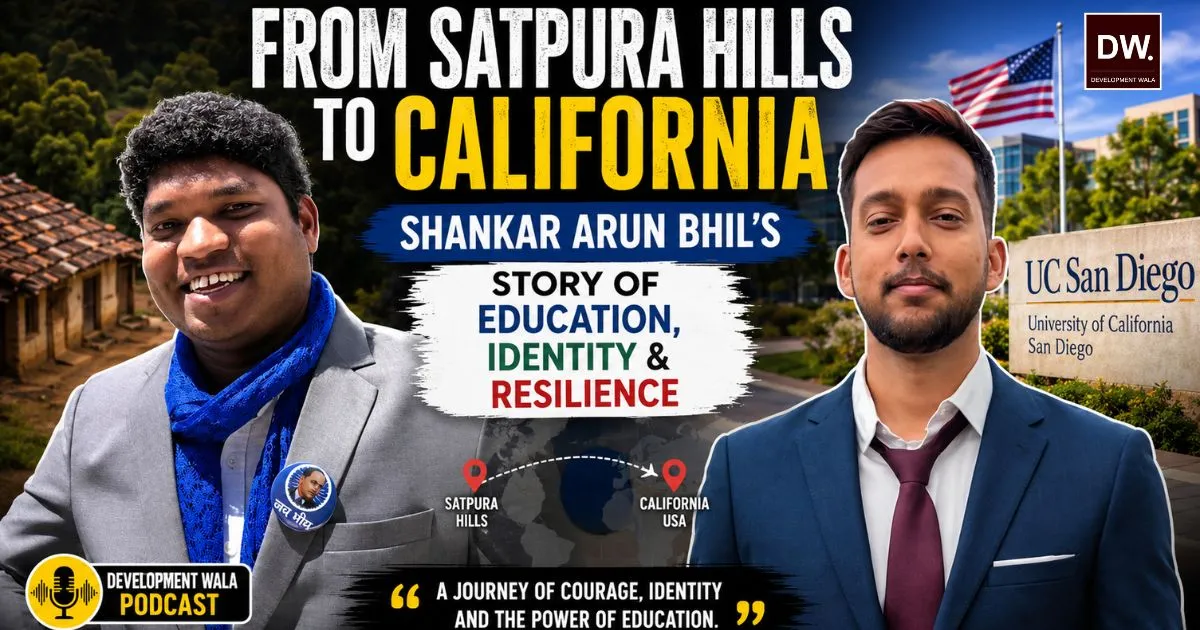
Yet that is exactly the story of Shankar Arun Bhil, a first-generation learner from Maharashtra’s Bhil tribal community who recently joined the PhD program in Ethnic Studies at the University of California, San Diego (UCSD).
His story is not simply an individual success story.
It is a story about education, identity, structural inequality, representation, and the possibilities that emerge when talent meets opportunity.
Watch the Full Podcast
🎙️ From Satpura Hills to California: Shankar Arun Bhil’s Story of Education, Identity & Resilience
Watch on YouTube:
Growing Up in a Tribal Village
Shankar was born into a Bhil family in rural Maharashtra. His childhood was shaped by agriculture, wage labour, and the realities of rural life.
Like many tribal families across India, his family faced challenges that rarely appear in policy documents: seasonal migration, limited educational infrastructure, unstable livelihoods, and distance from public services.
For many students in urban India, attending school is a routine part of childhood.
For many tribal students, it is a logistical challenge.
Children often study in residential Ashram schools located far from their homes. Parents migrate for agricultural labour. Families struggle to balance education with economic survival.
When discussing educational inequality, these structural realities are often overlooked.
The question is rarely whether tribal communities value education.
The question is whether educational systems are designed around the realities of their lives.
The Problem Is Bigger Than Reservation Debates
Public discussions about tribal communities frequently focus on reservation.
But as Shankar explains, reservation is often discussed without understanding the deeper structural barriers that exist long before a student reaches a college admission process.
Many families depend on seasonal migration for survival.
Children move with parents for sugarcane cutting, brick kiln work, cotton harvesting, or other forms of labour.
Schools become discontinuous.
Learning becomes interrupted.
Educational aspirations become difficult to sustain.
When students from such backgrounds eventually enter higher education institutions, they are often judged only by their examination scores rather than the social and economic realities they have overcome.
This is why representation matters.
Without representation, structural inequality remains invisible.
Discovering Sociology and a New Way of Seeing the World
After completing his schooling and later studying at Fergusson College in Pune, Shankar began exploring sociology.
Initially, the goal was simple: understand society better.
What followed was a deeper intellectual journey.
Through sociology, he encountered questions about caste, identity, tribal communities, power, and knowledge production.
He began noticing something important.
Many academic studies about tribal communities had historically been conducted through external lenses.
Communities were often described rather than heard.
Observed rather than represented.
Studied rather than engaged as knowledge producers.
For Shankar, this raised a fundamental question:
What happens when members of tribal communities become researchers themselves?
That question would eventually shape his academic journey.
Azim Premji University and the Search for Purpose
A major turning point came when Shankar joined Azim Premji University for his Master’s in Development.
Moving from Marathi-medium education into an English-medium academic environment was challenging.
Like many first-generation learners, he faced questions of confidence, language, and belonging.
Yet it was also the space where his intellectual interests became clearer.
Courses on development, land rights, caste, tribal studies, and social justice helped him connect personal experiences with larger structural questions.
Development was no longer simply a policy concept.
It became a way of understanding power, access, exclusion, and rights.
It was during this period that the idea of pursuing a PhD seriously emerged.
Not as a credential.
But as a way to contribute knowledge from within his community’s lived experiences.
Building a Path Towards a PhD
One of the most valuable parts of Shankar’s journey is that it demystifies the PhD application process.
Many students assume that admission to leading international universities is reserved for elite institutions or privileged backgrounds.
His experience suggests otherwise.
The process involved:
- Developing a clear research interest.
- Building an academic profile.
- Participating in conferences.
- Presenting research papers.
- Seeking mentorship.
- Identifying suitable departments and professors.
- Writing a strong Statement of Purpose.
- Building an academic CV.
- Reaching out to faculty members whose work aligned with his interests.
Most importantly, it required clarity about why he wanted to pursue a PhD.
According to Shankar, applicants should not begin with a university.
They should begin with a question.
A question they genuinely want to spend years exploring.
Why UC San Diego?
Shankar eventually secured admission to the Ethnic Studies PhD program at the University of California, San Diego.
For many students, university rankings dominate decision-making.
His approach was different.
He focused on:
- Faculty interests.
- Research alignment.
- Departmental strengths.
- Funding opportunities.
- Intellectual environment.
Ethnic Studies provided a space where questions about indigeneity, identity, marginalisation, race, and social justice could be explored in meaningful ways.
More importantly, the program aligned with the research questions he wanted to pursue.
Fully Funded Does Not Mean Easy
One misconception about international education is that funding automatically removes all challenges.
Funding reduces financial barriers.
It does not remove uncertainty.
Before leaving for the United States, Shankar experienced the same anxieties many students face.
Questions from family.
Pressure to start earning.
Concerns about age.
Uncertainty about long-term plans.
The period between receiving an admission offer and actually beginning the program can often be emotionally difficult.
These are realities that rarely appear in success stories.
Yet they are an important part of the journey.
His Message for Future Researchers
Perhaps the most important lesson from the conversation is that academic journeys are not built overnight.
They are built through consistent effort.
For students considering higher education abroad, Shankar’s advice is clear:
- Read deeply.
- Develop original questions.
- Seek mentorship.
- Build research experience.
- Learn academic writing.
- Start early.
- Be patient with the process.
He also offers an important caution regarding artificial intelligence tools.
AI can help simplify information, improve grammar, and support learning.
But research ultimately requires independent thinking.
Strong scholarship comes from reading, questioning, analysing, and developing original arguments.
No tool can replace that process.
Why This Story Matters
It is tempting to see Shankar’s journey as an exceptional story.
But doing so risks missing the larger lesson.
His success is not evidence that structural barriers do not exist.
It is evidence that talent exists everywhere.
What differs is access.
When educational opportunities, mentorship, institutional support, and persistence come together, students from historically marginalised communities can thrive in the world’s leading academic spaces.
The challenge before India is not finding talent.
The challenge is ensuring that talent is not lost because of geography, poverty, caste, language, or social exclusion.
Stories like Shankar Arun Bhil’s remind us what becomes possible when opportunity finally meets potential.
Development Wala | Decoding India’s Social Sector
Documenting the journeys, ideas, and experiences of practitioners, researchers, fellows, and changemakers shaping India’s development landscape.
Share Your Story with India’s Social Sector:
View podcast pageDiscover more from Development Wala
Subscribe to get the latest posts sent to your email.