
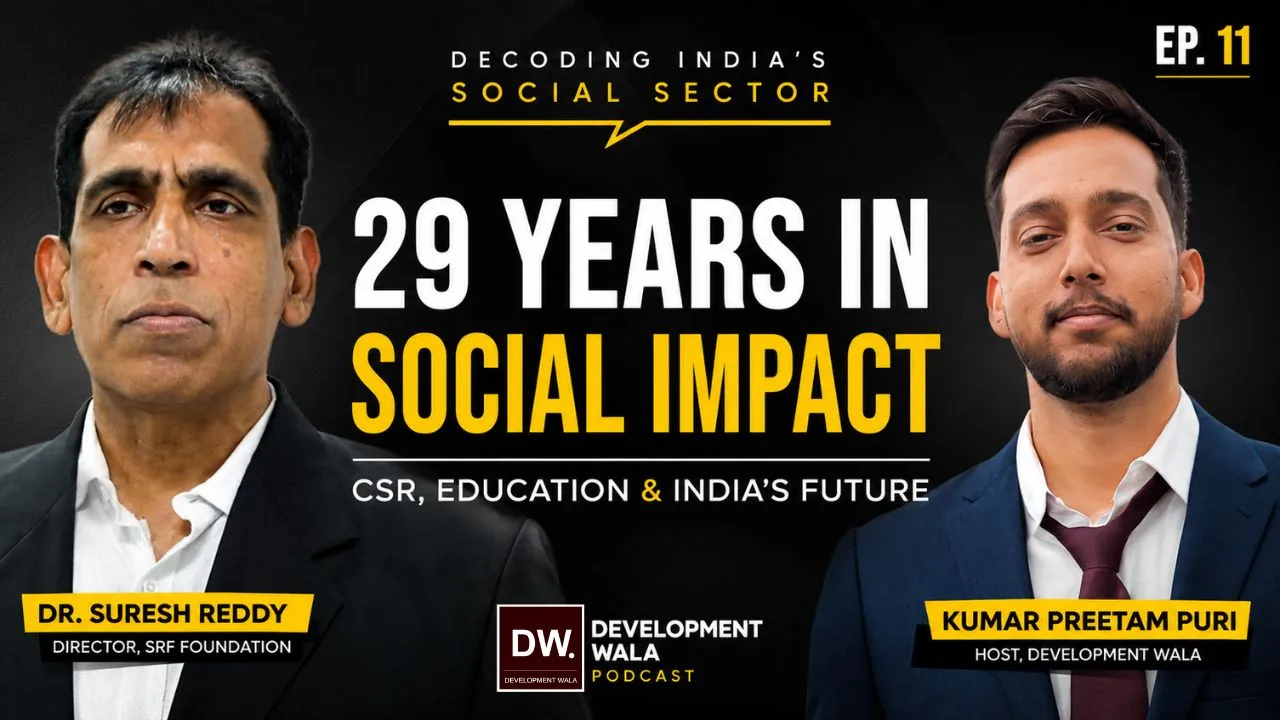
India’s development sector has undergone a remarkable transformation over the past three decades. From a time when non governmental organisations relied largely on grants and philanthropy to today’s structured Corporate Social Responsibility ecosystem, the country has witnessed significant progress in the way social change is designed, funded, and implemented.
At the heart of this transformation are leaders who have quietly dedicated their lives to improving education, strengthening communities, and building institutions that continue creating impact long after individual projects end.
One such leader is Dr. Suresh Reddy, Director of SRF Foundation, who brings nearly 29 years of experience spanning academia, government institutions, NGOs, and corporate CSR. Throughout his career, he has worked extensively in education, community development, skill development, institution building, and cross sector partnerships.
In this episode of Decoding India’s Social Sector, hosted by Kumar Preetam Puri, Dr. Reddy shared invaluable lessons from nearly three decades in the social sector. The conversation explored India’s changing education landscape, the evolution of CSR, the importance of building strong institutions, and why young professionals must begin their careers by working closely with communities.
Whether you are a student, development professional, CSR practitioner, NGO leader, policymaker, or someone aspiring to build a meaningful career in the social sector, this conversation offers practical insights that remain relevant for today’s rapidly evolving development landscape.
Podcast Overview
| Topic | Details |
|---|---|
| Guest | Dr. Suresh Reddy |
| Position | Director, SRF Foundation | Website: https://www.srf-foundation.org/ |
| Experience | Nearly 29 years in the development sector |
| Areas of Expertise | Education, CSR, Community Development, Institution Building, Leadership |
| Podcast Series | Decoding India’s Social Sector |
| Host | Kumar Preetam Puri |
| Key Themes | Education, School Transformation, CSR, NGO Partnerships, Leadership, Institution Building |
About Dr. Suresh Reddy
Dr. Suresh Reddy has spent nearly three decades working across multiple sectors including higher education, government programmes, civil society organisations, and corporate foundations. His diverse experience has enabled him to understand development challenges from different perspectives while designing practical solutions that improve people’s lives.
As the Director of SRF Foundation, he has played an instrumental role in expanding the Foundation’s work across education, employability, digital learning, and community development. Under his leadership, SRF Foundation has grown from a relatively small initiative into an organisation working across multiple Indian states with hundreds of professionals dedicated to creating long term social impact.
His work demonstrates that sustainable development is not achieved through isolated projects but through building institutions, strengthening systems, empowering communities, and creating partnerships that continue generating impact for years.
Sometimes Careers Choose Us Instead of the Other Way Around
One of the most inspiring moments during the conversation was hearing how Dr. Reddy entered the development sector.
Unlike many professionals who carefully plan every step of their career, his journey happened through unexpected opportunities.
After completing his education, he started working as a lecturer while simultaneously preparing for government examinations. Like many young Indians during the 1990s, securing a stable government job seemed like the obvious career path.
However, life had different plans.
In 1997, an opportunity took him to Delhi, where he entered the development sector. At that time, organised development work was still relatively unfamiliar to many young professionals, and CSR as we know it today did not exist.
The transition was far from easy.
Moving to a new city meant adapting to a completely different professional environment while learning about government systems, NGOs, donor agencies, schools, and grassroots communities.
Rather than viewing these challenges as obstacles, Dr. Reddy embraced them as learning opportunities.
Looking back today, he considers those early years the foundation of everything he later achieved.
His story reminds us that successful careers often emerge from remaining open to opportunities instead of following rigid plans.
For young professionals entering the social sector today, this lesson is particularly valuable. Sometimes the best opportunities arrive unexpectedly, and growth comes from embracing uncertainty with curiosity and commitment.
Education in India Has Changed Dramatically
Education has remained the central focus of Dr. Reddy’s professional journey.
Having worked in this field for nearly three decades, he has witnessed first hand how India’s education system has evolved.
One of the most significant changes has been the gradual migration of students from government schools to private schools.
Several decades ago, government schools were the primary choice for families across different economic backgrounds.
Today, parents increasingly associate private education with better opportunities, English medium instruction, modern infrastructure, and improved career prospects.
While acknowledging these changing aspirations, Dr. Reddy challenged a widespread misconception.
According to him, children studying in government schools are just as capable and talented as those studying in private institutions.
The real difference lies in access.
Access to quality teachers.
Access to learning resources.
Access to digital technologies.
Access to supportive school leadership.
Access to environments that encourage learning.
When these opportunities are strengthened, government school students consistently demonstrate exceptional potential.
This perspective shifts the conversation away from blaming children or teachers and instead focuses attention on improving systems that create equal opportunities for every learner.
It is a powerful reminder that educational inequality is rarely about ability. It is about access.
School Transformation Is Much More Than Constructing Buildings
One of the most insightful discussions during the podcast centred on the meaning of school transformation.
Many education initiatives focus on a single intervention.
Some organisations construct classrooms.
Others distribute computers.
Some improve sanitation facilities.
Others conduct teacher training programmes.
Each of these interventions adds value, but when implemented independently, they rarely produce lasting transformation.
Dr. Reddy explained that genuine school transformation requires an integrated approach where multiple elements work together.
According to him, successful schools are built upon four interconnected pillars that strengthen the entire educational ecosystem rather than addressing isolated challenges.
Physical Infrastructure Creates the Foundation
Every child deserves a learning environment that is safe, functional, and inspiring.
Quality classrooms, clean drinking water, separate sanitation facilities, playgrounds, libraries, science laboratories, and secure school buildings provide the physical foundation necessary for effective learning.
Although infrastructure alone cannot improve educational outcomes, its absence creates significant barriers to quality education.
Students cannot learn effectively in unsafe or poorly maintained environments.
Investment in infrastructure therefore remains an essential starting point for long term educational improvement.
Academic Excellence Must Remain the Priority
Buildings do not educate children.
Teachers do.
Strong academic systems, continuous teacher development, effective learning materials, updated curricula, and classroom support determine whether students truly learn.
Dr. Reddy emphasised that improving learning outcomes requires sustained investment in teaching quality rather than focusing solely on visible infrastructure projects.
SRF Foundation therefore places significant emphasis on strengthening classroom practices alongside improving physical facilities.
This balanced approach ensures that educational investments directly contribute to better learning outcomes rather than simply improving school appearance.
Digital Readiness Has Become Essential
Technology is transforming every aspect of education.
The pandemic further accelerated digital learning, making technological readiness an essential component of modern schooling.
Government schools increasingly require digital classrooms, computer laboratories, internet connectivity, digital content, and teachers who feel confident using educational technology.
Dr. Reddy explained that digital inclusion is no longer an optional enhancement.
It has become a necessity for preparing students for higher education, employment, and participation in an increasingly digital economy.
Equipping schools with technology while simultaneously building teachers’ digital capabilities ensures that technology enhances learning rather than becoming underutilised infrastructure.
Leadership and Community Ownership Drive Sustainable Change
While infrastructure, academic excellence, and technology are essential, Dr. Reddy believes that the fourth pillar of school transformation is often the most important.
Leadership.
Schools cannot be transformed by external funding alone.
Long term success depends on the commitment of school leaders, teachers, parents, School Management Committees, local governments, and communities.
When these stakeholders actively participate in the development process, schools become stronger institutions rather than projects dependent on external organisations.
Dr. Reddy explained that sustainable development begins when communities take ownership of change. External organisations may initiate programmes, provide technical expertise, or mobilise resources, but meaningful transformation occurs only when local stakeholders become active partners.
This philosophy reflects one of the most important principles of community development. People support what they help create. When communities feel ownership, improvements continue long after a project officially concludes.
Building Institutions Instead of Projects
One of the strongest messages from the conversation was the importance of institution building.
Many development initiatives focus on delivering successful projects.
Projects have clear timelines.
Defined budgets.
Specific deliverables.
However, projects eventually end.
Institutions continue creating impact for decades.
Dr. Reddy highlighted the remarkable journey of SRF Foundation as an example of this philosophy.
Beginning nearly eighteen years ago with a relatively small team working in Mewat near Gurugram, the Foundation has grown into an organisation employing around 300 professionals across 13 Indian states.
This growth was not accidental.
It required strategic planning.
Strong governance.
Robust systems.
Continuous learning.
Leadership development.
Most importantly, it required creating an organisation capable of adapting to changing development challenges.
He emphasised that lasting social impact cannot depend upon individual leaders alone.
People eventually move on.
Institutions preserve knowledge.
They create consistency.
They establish systems that allow future generations of professionals to continue delivering impact.
For NGOs, foundations, and social enterprises, this lesson is particularly relevant.
Success should not be measured only by the number of projects completed but by the strength of the institution delivering those projects.
Why Partnerships Have Become Essential in Today’s Development Sector
No single organisation can solve complex social challenges independently.
Whether addressing education, employability, healthcare, climate change, livelihoods, or digital inclusion, sustainable solutions require collaboration between multiple stakeholders.
Throughout the discussion, Dr. Reddy repeatedly emphasised the growing importance of partnerships.
SRF Foundation has successfully collaborated with organisations including Microsoft, IBM, Shell, government departments, educational institutions, and numerous community based organisations.
These partnerships demonstrate how different sectors contribute unique strengths.
Corporate organisations often provide financial resources, technology, innovation, management expertise, and operational efficiency.
Government contributes scale, policy support, infrastructure, and institutional reach.
Non governmental organisations contribute grassroots knowledge, community trust, implementation expertise, and long term engagement with beneficiaries.
When these strengths come together, development initiatives become significantly more effective than isolated interventions.
Partnerships also encourage innovation by bringing together diverse perspectives, allowing organisations to learn from one another while addressing shared development goals.
As India’s social sector continues evolving, collaborative models will become increasingly important for achieving sustainable and scalable impact.
Understanding the Evolution of Corporate Social Responsibility in India
Corporate Social Responsibility has transformed India’s development landscape over the past decade.
Before mandatory CSR legislation, many companies supported philanthropic initiatives through voluntary contributions.
Today, CSR has become a structured ecosystem focused on measurable outcomes, accountability, transparency, and long term impact.
Dr. Reddy explained how this transformation has reshaped relationships between corporations and NGOs.
Corporate organisations typically operate with clearly defined targets, timelines, performance indicators, financial accountability, and operational efficiency.
Development organisations, on the other hand, traditionally focused on addressing complex social challenges that often required flexibility and long term engagement.
Initially, these different working cultures created challenges.
However, mandatory CSR encouraged NGOs to strengthen project management, financial reporting, monitoring systems, documentation, governance, and impact measurement.
Rather than viewing these requirements as administrative burdens, Dr. Reddy believes they have helped professionalise India’s development sector.
Better documentation enables organisations to demonstrate their impact more effectively.
Improved governance strengthens donor confidence.
Transparent reporting builds trust.
Ultimately, stronger systems enable organisations to serve communities more effectively.
CSR Should Go Beyond Compliance
An especially thought provoking insight from the conversation centred on how organisations should approach CSR.
Dr. Reddy encouraged companies to move beyond viewing CSR as a legal obligation or annual budget that simply needs to be utilised before the financial year ends.
Instead, CSR should become a long term investment in sustainable development.
Meaningful CSR initiatives create measurable improvements in education, livelihoods, healthcare, environmental sustainability, and community wellbeing.
Similarly, NGOs must continue strengthening their organisational capacity to meet increasing expectations around governance, transparency, compliance, and impact measurement.
Trust develops when both sectors understand each other’s priorities while working towards shared social objectives.
Why Every Young Professional Should Begin at the Grassroots
Towards the end of the podcast, I asked Dr. Reddy what advice he would give to students and young professionals aspiring to build careers in the development sector.
His answer was immediate.
Start from the ground.
Spend time in communities.
Listen before proposing solutions.
Observe daily realities.
Understand people’s aspirations.
Learn directly from those experiencing development challenges.
Field experience builds empathy that no classroom, textbook, or policy document can fully provide.
Today, many graduates aspire to begin their careers in consulting, policy research, programme management, or leadership positions.
While these roles are valuable, they become far more effective when informed by genuine field experience.
Development work is fundamentally about people.
Without understanding communities, even technically strong solutions may fail to create meaningful change.
For aspiring development professionals, grassroots engagement remains one of the greatest investments they can make in their careers.
Passion Is the Foundation of a Long Term Career
Technical knowledge, academic qualifications, fellowships, and professional skills are all important.
However, Dr. Reddy believes one quality remains indispensable.
Passion.
The development sector offers extraordinary opportunities to improve lives.
Yet it also presents complex challenges.
Progress is often gradual.
Resources may be limited.
Success requires patience.
Social transformation rarely happens overnight.
Without a genuine commitment to serving communities and creating positive change, sustaining a long term career in this sector becomes difficult.
His message serves as a reminder that meaningful careers are built through purpose, perseverance, and continuous learning rather than qualifications alone.
Key Lessons from the Podcast
This conversation offered valuable lessons for professionals across the social impact ecosystem.
Some of the biggest takeaways include:
- Careers often develop through unexpected opportunities rather than perfect planning.
- Educational inequality is primarily about access to opportunities rather than differences in student ability.
- School transformation requires integrated investments in infrastructure, academics, digital readiness, and leadership.
- Sustainable impact depends on building institutions rather than delivering isolated projects.
- Collaboration between government, corporates, NGOs, and communities is essential for solving complex social challenges.
- CSR should focus on creating measurable long term impact rather than merely fulfilling compliance requirements.
- Grassroots experience builds empathy and strengthens future leadership.
- Passion remains essential for sustaining a fulfilling career in the development sector.
Why This Conversation Matters Today
India’s social sector is entering a new era.
Corporate Social Responsibility continues to grow.
Technology is reshaping education and development programmes.
Government and civil society partnerships are expanding.
Young professionals are increasingly seeking meaningful careers that combine purpose with professional growth.
Against this backdrop, the experiences shared by Dr. Suresh Reddy provide valuable guidance for anyone working to strengthen education, communities, and institutions.
His career demonstrates that sustainable development is not achieved through short term projects or individual achievements.
It is built patiently through leadership, collaboration, institutional strength, and a long term commitment to serving communities.
Frequently Asked Questions
Who is Dr. Suresh Reddy?
Dr. Suresh Reddy is the Director of SRF Foundation with nearly 29 years of experience across academia, government institutions, NGOs, and corporate CSR. His work focuses on education, community development, employability, leadership, and institution building.
What is SRF Foundation?
SRF Foundation is the corporate social responsibility arm of SRF Limited. The Foundation works across education, skill development, community development, and livelihood initiatives in multiple Indian states.
What are the four pillars of school transformation discussed in the podcast?
According to Dr. Reddy, school transformation requires four integrated pillars.
Physical infrastructure.
Academic excellence.
Digital readiness.
Leadership and community ownership.
Why are partnerships important in the development sector?
Partnerships combine the strengths of governments, corporates, NGOs, educational institutions, and communities, enabling organisations to create larger and more sustainable social impact than they could achieve individually.
What advice does Dr. Reddy give to young professionals?
He encourages young professionals to begin their careers at the grassroots, learn directly from communities, develop empathy, remain curious, and build their careers with passion and purpose.
Conclusion
Hosting conversations through Decoding India’s Social Sector continues to reinforce one important truth. Behind every successful programme, every transformed school, and every empowered community are dedicated individuals who quietly spend decades building systems that improve lives.
Dr. Suresh Reddy’s remarkable journey illustrates that lasting social impact is created through institutions rather than individuals, collaboration rather than competition, and long term commitment rather than short term projects.
As India’s development ecosystem continues to evolve through stronger CSR practices, innovative partnerships, and expanding educational opportunities, these lessons become increasingly relevant for students, professionals, NGOs, CSR leaders, policymakers, and social entrepreneurs.
If you are passionate about education, leadership, community development, or creating meaningful social impact, this conversation offers practical insights that will inspire and inform your own journey.
Watch the Full Podcast
Watch the complete conversation with Dr. Suresh Reddy, Director of SRF Foundation, on the Development Wala YouTube Channel and gain deeper insights into leadership, education, CSR, and institution building in India’s social sector.
Watch the episode on YouTube: https://youtu.be/jnO9UHE8bIM
Listen to it on Spotify:
If you found this conversation valuable, consider sharing it with your colleagues, students, fellow development professionals, and anyone interested in building a stronger and more equitable India.
Website: http://developmentwala.com
Job board: developmentwala.org
LinkedIn: https://www.linkedin.com/company/development-wala
Job Board LinkedIn: https://www.linkedin.com/company/developmentwalajobboard/
WhatsApp Channel: https://whatsapp.com/channel/0029VaCxEqA0G0XoVCQyUx38
YouTube: https://www.youtube.com/@DevelopmentWalaofficial
Instagram: http://instagram.com/developmentwala_official
Facebook: https://www.facebook.com/thedevelopmentwala
READ MORE
- 29 Years of Social Impact: Dr. Suresh Reddy on CSR, Education, School Transformation and Building Strong Institutions in India

- Building 1 Million Better Teachers: Mainak Roy’s Vision for Transforming Education in India Ep10

- From IIT Kharagpur to Majuli: How Bipin Dhane Left a Global Engineering Career to Transform Education and Livelihoods in Assam

- From Satpura Hills to California: How Shankar Arun Bhil’s Journey Challenges Everything We Think We Know About Opportunity

- The Future of Rural India: Narendranath Damodaran on Natural Farming, PRADAN, and Reimagining Development

Discover more from Development Wala
Subscribe to get the latest posts sent to your email.