
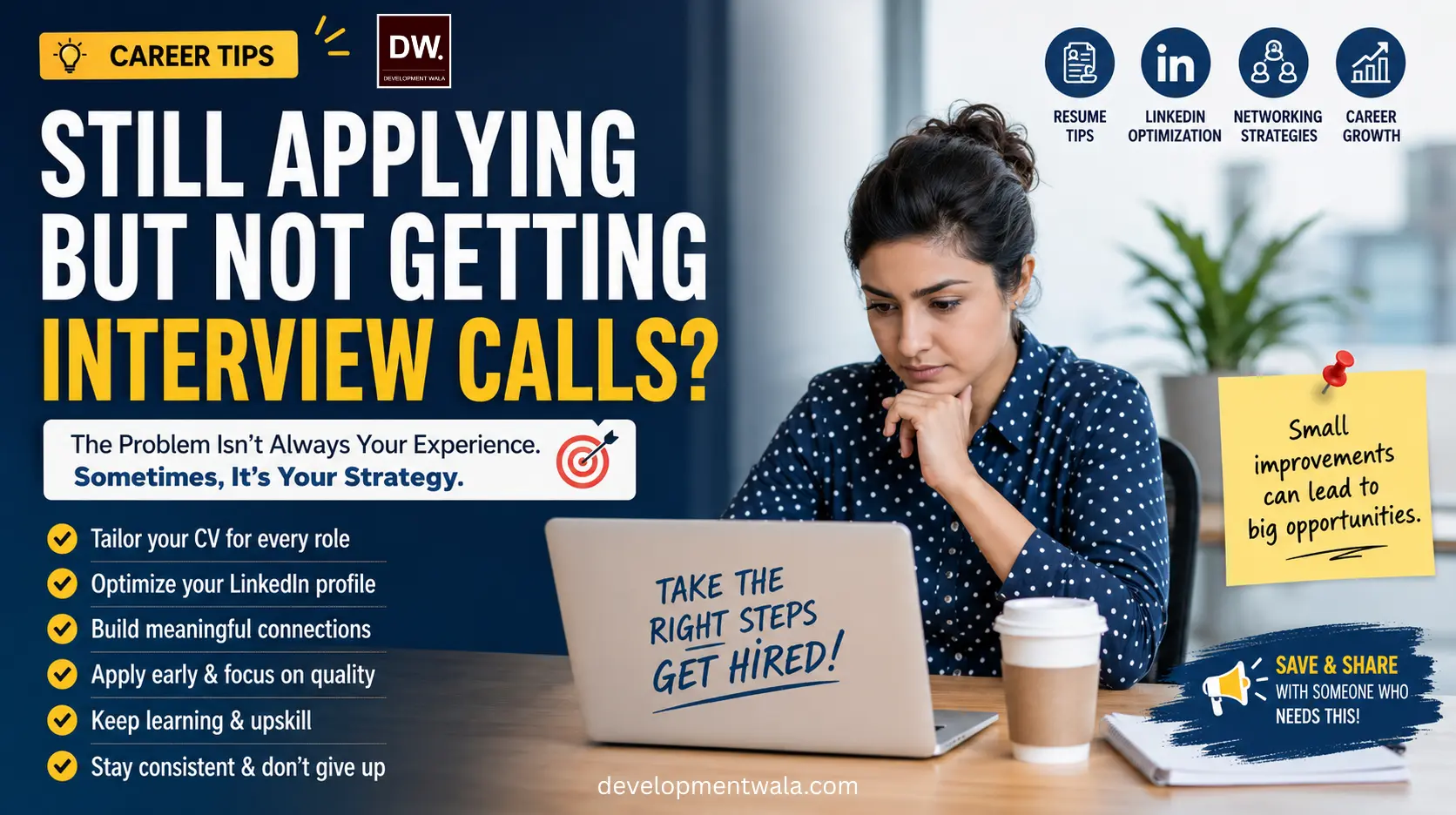
Applying to dozens or even hundreds of jobs without receiving interview calls can be frustrating. Many job seekers begin to question their qualifications, confidence, and career choices. However, the reality is that the problem is not always your experience or education. More often, it is the strategy you use during your job search.
Recruiters today receive hundreds of applications for a single role. Before your resume reaches a hiring manager, it often passes through an Applicant Tracking System (ATS), recruiter screening, and multiple evaluation stages. This means that even qualified candidates can be overlooked if their applications are not optimized.
Whether you are a recent graduate, an experienced professional, or someone looking to transition into the development sector, improving your job search strategy can dramatically increase your chances of getting interview calls.
In this guide, we explore practical, recruiter backed strategies that can help you stand out in today’s competitive job market.
Why Good Candidates Still Don’t Get Interview Calls
Many candidates assume that more applications automatically lead to more opportunities. Unfortunately, this is rarely true.
Recruiters are looking for candidates who clearly demonstrate how their skills match the specific role. Sending the same resume to every employer often results in rejection because it fails to address the employer’s unique requirements.
Hiring today is driven by technology, data, and targeted recruitment practices. Companies increasingly rely on ATS software to shortlist applications before a human recruiter even reviews them. If your resume does not match the job description, it may never be seen.
Instead of asking, “Why am I not getting interviews?” consider asking, “How can I make my application more relevant to each employer?”
The Modern Hiring Process
Understanding how companies hire can help you improve your approach.
| Stage | What Recruiters Look For | How You Can Improve |
|---|---|---|
| Resume Screening | Relevant skills and keywords | Tailor every CV |
| ATS Screening | Matching keywords | Use job description terminology |
| Recruiter Review | Clear achievements | Quantify your impact |
| Interview Selection | Strong fit for role | Demonstrate relevant experience |
| Final Hiring Decision | Skills, culture fit, communication | Prepare thoroughly |
Knowing these stages allows you to optimize each part of your application instead of relying on luck.
1. Tailor Your Resume for Every Job Application
One of the biggest mistakes job seekers make is using the same resume for every application.
Each job description contains valuable clues about what employers want. Carefully read the responsibilities, required qualifications, and preferred skills. Then modify your resume to reflect those requirements honestly.
For example, if a position emphasizes project management, stakeholder engagement, and monitoring and evaluation, those experiences should appear prominently if they accurately represent your background.
Tailoring your resume does not mean inventing experience. It means highlighting your most relevant accomplishments.
2. Optimize Your Resume for Applicant Tracking Systems
Applicant Tracking Systems have become a standard part of recruitment across many industries.
To improve ATS compatibility:
Use standard section headings such as Experience, Education, Skills, and Certifications.
Include relevant keywords from the job description naturally.
Avoid complicated graphics, tables, icons, and text boxes.
Save your resume in the preferred format requested by the employer.
Use a clean, professional layout.
A resume that is ATS friendly has a much higher chance of reaching a recruiter.
3. Quantify Your Achievements
Many resumes simply describe responsibilities.
Instead of writing:
“Managed community projects.”
Write:
“Managed five community development projects serving more than 2,000 beneficiaries across three districts.”
Numbers demonstrate credibility and make your achievements easier for recruiters to understand.
Examples include:
Increased program participation by 35 percent.
Managed budgets exceeding ₹50 lakh.
Led a team of 15 volunteers.
Delivered training to over 500 participants.
Recruiters remember measurable impact.
4. Build a Strong LinkedIn Profile
Your LinkedIn profile is often your digital first impression.
An optimized profile should include:
A professional photograph.
A clear headline that explains what you do.
A compelling About section.
Detailed work experience.
Skills relevant to your industry.
Recommendations from colleagues or supervisors.
A customized LinkedIn URL.
Recruiters regularly search LinkedIn using keywords. If your profile contains the right skills and experience, you are more likely to appear in recruiter searches.
5. Focus on Networking Instead of Only Applying
Many opportunities are filled before they are publicly advertised.
Networking helps you discover hidden opportunities and gain referrals.
Effective networking includes:
Connecting with professionals in your industry.
Participating in webinars and conferences.
Joining LinkedIn groups.
Engaging thoughtfully with industry content.
Reaching out respectfully to recruiters.
Building relationships should be genuine. Avoid sending connection requests followed immediately by requests for jobs.
6. Apply Early
Timing matters.
Many recruiters begin reviewing applications as soon as they are submitted. By the time the deadline arrives, the shortlist may already be prepared.
Whenever possible:
Set job alerts.
Apply within the first few days.
Submit complete and accurate applications.
Early applications often receive more attention.
7. Quality Always Beats Quantity
Sending 300 generic applications rarely produces better results than submitting 30 well researched applications.
Before applying, ask yourself:
Do I meet most of the requirements?
Have I customized my resume?
Have I written a strong cover letter?
Have I researched the organization?
A thoughtful application demonstrates genuine interest.
8. Write Better Cover Letters
Many applicants skip cover letters altogether.
A strong cover letter should explain:
Why you are interested in the organization.
How your experience matches the role.
The value you can bring.
Keep it concise, personalized, and focused on the employer rather than yourself.
9. Continue Learning While Searching
Employers value candidates who continue developing their skills.
Consider learning:
Project management.
Data analysis.
Monitoring and evaluation.
Digital marketing.
Artificial intelligence tools.
Microsoft Excel.
Grant writing.
Safeguarding.
Depending on your field, even one relevant certification can strengthen your profile significantly.
10. Prepare Before You Receive an Interview
Many candidates only start preparing after receiving an interview invitation.
Instead:
Practice common interview questions.
Research organizations.
Prepare examples using the STAR method.
Review your resume.
Stay informed about industry trends.
Preparation improves confidence.
11. Build Your Personal Brand
Recruiters increasingly evaluate candidates beyond their resumes.
Share insights on LinkedIn.
Publish articles.
Volunteer for meaningful projects.
Speak at webinars.
Contribute to professional communities.
Your online presence should reinforce your expertise.
12. Track Every Application
Maintain a spreadsheet containing:
Organization name.
Role applied.
Application date.
Follow up date.
Interview status.
Application source.
Tracking helps identify patterns and prevents duplicate applications.
13. Ask for Feedback
Whenever possible, request feedback after interviews.
While not every employer provides detailed comments, constructive feedback can help identify recurring weaknesses.
Improving after every interview increases your long term success.
14. Don’t Ignore Soft Skills
Technical qualifications matter, but employers also value:
Communication.
Leadership.
Adaptability.
Problem solving.
Collaboration.
Critical thinking.
Demonstrate these skills throughout your resume, LinkedIn profile, and interviews.
15. Stay Consistent
Job searching is emotionally challenging.
Some candidates receive offers within weeks.
Others require several months.
Consistency matters more than motivation.
Create a weekly routine:
Apply for targeted roles.
Update LinkedIn.
Network with professionals.
Learn a new skill.
Review your resume.
Consistency compounds over time.
Common Mistakes That Reduce Interview Calls
Many applicants unknowingly hurt their chances by making avoidable mistakes.
These include:
Using the same resume everywhere.
Ignoring ATS keywords.
Having spelling or grammar mistakes.
Applying without researching the employer.
Writing generic cover letters.
Having an incomplete LinkedIn profile.
Not following application instructions.
Applying for roles without meeting basic qualifications.
Avoiding these mistakes alone can significantly improve your interview rate.
Job Search Tips for Development Sector Professionals
The development sector has its own recruitment expectations.
If you are applying for NGO jobs, CSR roles, UN opportunities, research organizations, or international development positions:
Highlight measurable community impact.
Demonstrate stakeholder engagement.
Include project management experience.
Show evidence of monitoring and evaluation skills.
Mention proposal writing or fundraising experience.
Highlight safeguarding and compliance knowledge where relevant.
Show language skills if applicable.
Employers in the development sector often prioritize practical impact alongside academic qualifications.
Weekly Job Search Checklist
Use this checklist to improve your job search.
| Task | Completed |
|---|---|
| Tailored resume for each application | □ |
| Updated LinkedIn profile | □ |
| Connected with new professionals | □ |
| Applied to high quality opportunities | □ |
| Learned one new skill | □ |
| Practiced interview questions | □ |
| Followed up on previous applications | □ |
| Reviewed resume for improvements | □ |
Following this consistently can help you stay organized and productive.
Frequently Asked Questions
Why am I not getting interview calls despite having experience?
Your resume may not be tailored to the specific role, your ATS optimization may be weak, or your LinkedIn profile may not effectively showcase your achievements.
How many jobs should I apply for every week?
Quality matters more than quantity. Focus on submitting well researched, customized applications rather than applying to as many jobs as possible.
Is LinkedIn really important?
Yes. Many recruiters actively search LinkedIn for candidates before advertising positions. A strong profile increases your visibility.
Should I always write a cover letter?
If the employer allows one, yes. A personalized cover letter can distinguish you from candidates who only submit resumes.
Can online certifications improve my chances?
Relevant certifications demonstrate continuous learning and may strengthen your application, particularly when they align with the job requirements.
Final Thoughts
Receiving fewer interview calls than expected does not necessarily mean you lack the qualifications for the roles you are applying for. In many cases, success depends on presenting your skills in a way that aligns with the employer’s expectations.
The most successful job seekers are not always the ones with the strongest academic background or the longest work history. They are often the candidates who understand how modern recruitment works, continuously improve their application materials, build professional relationships, and remain consistent in their efforts.
Every application is an opportunity to learn. Every interview provides valuable experience. Every improvement you make to your resume, LinkedIn profile, or networking strategy increases your chances of landing the right opportunity.
Rather than focusing only on the number of applications you submit, focus on making each application stronger than the last. Small improvements made consistently can lead to significantly better results over time.
At Development Wala, we are committed to helping job seekers build meaningful careers in the development sector and beyond. Continue learning, stay persistent, and remember that the right opportunity often comes to those who prepare for it.
References (Harvard Style)
Harvard Business Review (2024) How to Stand Out in a Competitive Job Market.
Indeed Hiring Lab (2024) Labour Market Trends and Hiring Insights.
Jobscan (2025) Applicant Tracking System Resume Guide.
LinkedIn (2025) Workforce Report and Future of Hiring.
Resume Genius (2025) Resume Statistics and Hiring Trends.
Society for Human Resource Management (SHRM) (2025) Hiring and Recruitment Best Practices.
TopResume (2025) Common Resume Mistakes That Prevent Interviews.
Development Wala Hiring 2026: Submit Your CV for Top Social Sector Jobs in India
Submit your CV
Follow us and stay updated on the latest Non-Profit / social work Jobs and opportunities
Follow Kumar Preetam Puri on Linkedin: https://www.linkedin.com/in/kumarpreetampuri/
Development Wala LinkedIn Page: https://www.linkedin.com/company/development-wala/
WhatsApp channel: https://whatsapp.com/channel/0029VaCxEqA0G0XoVCQyUx38
Instagram: https://www.instagram.com/developmentwala_official/
Discover more from Development Wala
Subscribe to get the latest posts sent to your email.