
Education is often described as the foundation of a nation’s future. Yet discussions about improving education frequently revolve around students, school buildings, technology, or examination results. Rarely do teachers receive the attention they deserve as the primary drivers of meaningful change.
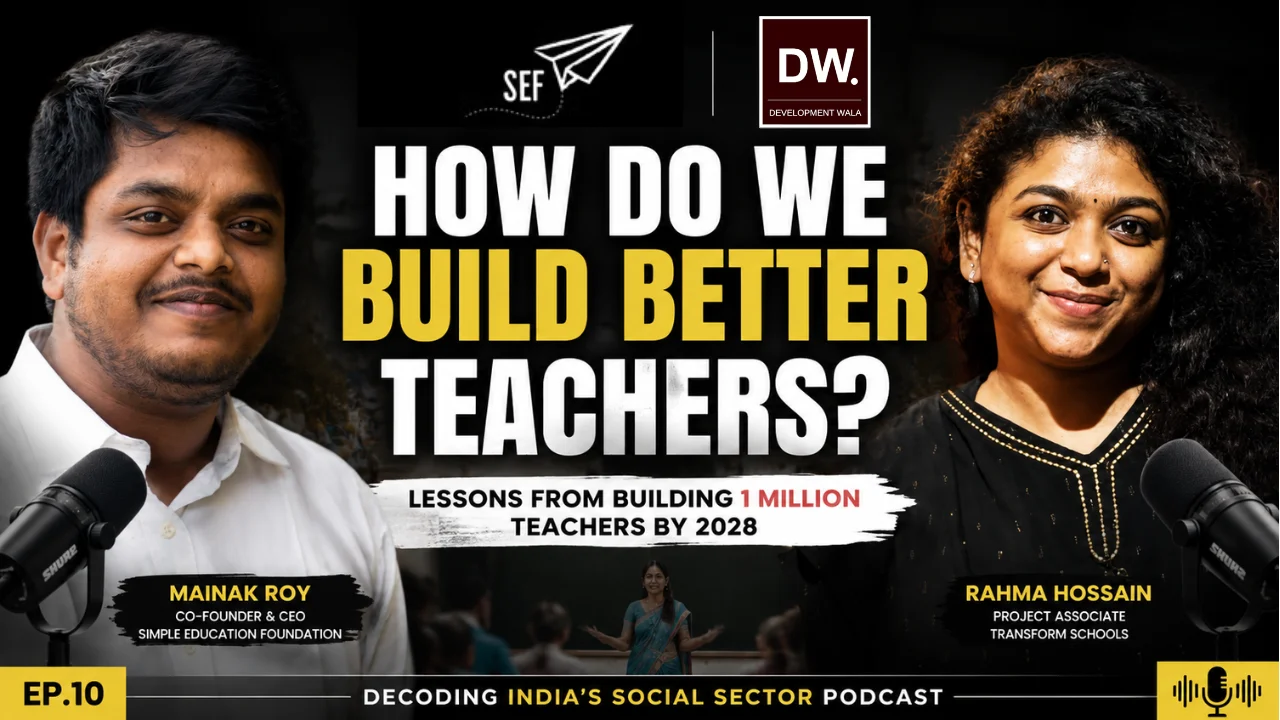
In Episode 10 of Decoding India’s Social Sector, Development Wala spoke with Mainak Roy, Co-founder and CEO of Simple Education Foundation (SEF), about his journey from a Teach For India Fellow to leading one of India’s most influential organizations focused on teacher professional development.
The conversation reveals an important truth. Improving education is not simply about creating better classrooms. It is about building better systems that empower teachers, strengthen institutions, and create sustainable change across government schools.
Mainak’s journey demonstrates that education reform is a marathon rather than a sprint. It requires patience, humility, evidence-based decision making, and a deep respect for the people working inside the system every day.
Table of Contents
- From Personal Ambition to Social Purpose
- A Classroom Experience That Changed Everything
- Why Teachers Need More Than Training
- Building Simple Education Foundation
- Scaling Impact Through Government Partnerships
- Leadership Beyond Individual Heroes
- The Reality of Fundraising in the Social Sector
- AI in Education Must Solve Real Problems
- Advice for Future Development Professionals
- Key Takeaways
- FAQs
- Conclusion
Episode Snapshot
| Topic | Details |
|---|---|
| Guest | Mainak Roy |
| Organisation | Simple Education Foundation |
| Role | Co-founder and CEO |
| Podcast | Decoding India’s Social Sector |
| Host | Rahma Hossain |
| Core Theme | Transforming education through teacher development |
| Focus Areas | Teacher competency, public education, systems change, leadership, AI in education |
From Personal Ambition to Social Purpose
Like many young graduates, Mainak Roy did not begin his career with a dream of changing India’s education system. His priorities were familiar: completing college, finding employment, and figuring out his future.
Everything changed when he joined the Teach For India Fellowship.
Working inside a government classroom exposed him to realities that could never be understood through statistics or policy reports. He began to witness how deeply inequality shapes children’s lives, opportunities, and futures.
Instead of viewing education merely as a profession, he began to understand it as one of the most powerful tools for addressing social inequity.
“Equity stopped being an abstract idea and became something deeply personal.”
This shift laid the foundation for everything that followed.
A Classroom Experience That Changed Everything
Among the defining moments of Mainak’s journey was the tragic loss of one of his students, Tabassum.
She died after contracting dengue because her family could not access timely medical treatment. Only a few months later, Mainak himself contracted the same illness.
The difference was striking.
He recovered because he had access to quality healthcare, financial resources, and social support.
The disease was identical.
The outcomes were completely different.
The experience forced him to confront the reality that privilege often determines survival, opportunity, and success more than talent alone.
Education, he realized, exists within this larger ecosystem of inequality.
Schools cannot solve every societal problem, but they can create opportunities that help break cycles of disadvantage.
Why Teachers Need More Than Training
While working closely with government schools, Mainak observed something that challenged common assumptions.
Teachers were not lacking commitment.
They were lacking support.
Many government school teachers demonstrated extraordinary dedication despite operating in difficult environments with limited resources, large classrooms, and increasing administrative responsibilities.
Traditional teacher training programs existed, but they often followed a one size fits all approach.
Sessions were largely theoretical.
Learning was disconnected from classroom realities.
Teachers attended workshops, received certificates, and returned to classrooms without practical solutions for the challenges they faced every day.
This highlighted an important gap.
Professional development should not be viewed as a single event.
It should be an ongoing process of coaching, reflection, experimentation, and improvement.
Key Insight
Teacher development is educational infrastructure.
Investing in teachers creates lasting improvements that benefit generations of students.
Building Simple Education Foundation
Simple Education Foundation emerged from this understanding.
Rather than designing solutions from offices, the organization chose to spend significant time inside schools.
Listening became its starting point.
Teachers shared their daily struggles.
Students described their learning experiences.
School leaders highlighted systemic barriers.
Only after understanding these realities did the organisation begin designing interventions.
This human centred approach helped SEF create practical tools that teachers could actually use.
Mainak reflects that if he were starting again today, he would adopt an even clearer product service model.
Instead of attempting to solve every educational challenge simultaneously, he would build focused, high quality tools addressing specific classroom problems while providing ongoing support around them.
This reflects an important lesson for nonprofit organisations.
Trying to solve everything often results in solving very little.
Focused interventions usually generate stronger evidence and greater impact.
Scaling Through Government Systems
One of the biggest misconceptions about social impact is that scaling always requires expanding an organisation independently.
Mainak believes otherwise.
True scale comes from strengthening public systems.
India has millions of children enrolled in government schools.
No nonprofit, regardless of its size, can reach every classroom independently.
Governments already possess the infrastructure.
They have schools.
Teachers.
Administrative systems.
District officials.
State education departments.
The challenge lies in improving how these systems function.
This is why Simple Education Foundation works closely with state governments rather than creating parallel systems.
By developing teacher competency frameworks, supporting instructional coaching, and strengthening institutional capacity, SEF enables governments to improve education at scale.
This approach represents systems change rather than project based intervention.
Leadership Is About Building Institutions
Throughout the conversation, Mainak repeatedly shifts attention away from individual achievements.
Leadership, he argues, is not about becoming the hero of the story.
It is about building organisations capable of creating impact long after individual leaders move on.
Many nonprofits struggle because they become closely associated with charismatic founders.
Institutional strength suffers when decision making depends on one individual.
Effective leaders instead create cultures where teams learn continuously, share ownership, and improve systems together.
This philosophy mirrors SEF’s work with teachers.
Just as teachers should be empowered rather than controlled, organisations should build distributed leadership rather than concentrating authority.
Understanding the Reality of Fundraising
Fundraising remains one of the greatest challenges for nonprofit organisations.
Mainak describes it as a continuous cycle of highs and lows.
There is never a point where funding concerns disappear permanently.
Instead of viewing fundraising simply as securing money, he encourages organisations to understand different kinds of funders.
Some invest because they care deeply about education.
Others prioritise innovative approaches and measurable evidence.
A third group believes primarily in leadership teams.
Understanding these motivations helps organisations communicate their work more effectively.
Perhaps the most valuable insight concerns rejection.
Every declined proposal offers an opportunity for reflection.
Repeated rejection may indicate the need to revisit programme design, strengthen evidence, or clarify organisational strategy.
Rather than treating rejection as failure, organisations can use it to improve.
AI in Education Should Solve Real Problems
Artificial intelligence dominates conversations about the future of education.
Mainak welcomes technological innovation but cautions against assuming technology alone can transform classrooms.
Technology is only useful when it responds to real needs.
Many schools in rural India continue to struggle with unreliable electricity and limited internet connectivity.
Designing sophisticated AI powered tools without considering these realities risks increasing educational inequality rather than reducing it.
He argues that accessibility should guide innovation.
If teachers need forty five minutes to learn a digital platform, adoption will remain low.
If technology saves teachers time through simple interfaces, voice notes, or intuitive workflows, meaningful adoption becomes far more likely.
Technology should simplify teaching.
It should never complicate it.
Building Teacher Dignity
One of the strongest themes emerging from the discussion is dignity.
Public conversations often portray teachers as obstacles to educational reform.
Mainak challenges this narrative.
Teachers deserve trust, professional respect, and opportunities to grow.
When teachers feel valued, they become more confident.
Confident teachers create engaging classrooms.
Engaged classrooms improve student learning.
Teacher dignity therefore becomes an essential component of educational quality rather than an optional ideal.
Professional development should not communicate that teachers are failing.
It should communicate that teachers deserve continuous opportunities to learn, just like professionals in every other field.
Advice for the Next Generation of Development Professionals
Towards the end of the conversation, Mainak offers practical advice for young professionals entering the social sector.
Build Deep Expertise
Rather than trying to know everything, develop mastery in one domain such as curriculum design, monitoring and evaluation, fundraising, policy, or research.
Specialists often create greater value than generalists.
Be Patient
Social change unfolds slowly.
Projects require years before meaningful outcomes become visible.
Long term commitment enables practitioners to understand systems rather than isolated events.
Learn Beyond Your Sector
Education cannot be understood independently of health, gender, technology, livelihoods, governance, or social justice.
Cross disciplinary learning produces more effective solutions.
Reflect Constantly
Technical knowledge matters.
Character matters equally.
Regular self reflection helps leaders align their decisions with their values and purpose.
Key Takeaways
• Teacher development is one of the strongest investments in educational quality.
• Government partnerships are essential for achieving scale.
• Continuous coaching is more effective than one time training.
• Leadership should focus on building institutions rather than individual recognition.
• Fundraising requires resilience, adaptability, and continuous learning.
• Technology should reduce complexity instead of creating new barriers.
• Teacher dignity directly influences classroom learning.
• Sustainable education reform requires patience and long term commitment.
Conclusion
Mainak Roy’s journey illustrates that transforming education is not about finding quick fixes. It is about strengthening the people and systems that shape learning every day.
Simple Education Foundation demonstrates that investing in teachers creates ripple effects extending far beyond individual classrooms. When teachers receive meaningful support, students learn better. When governments adopt stronger professional development systems, millions of children benefit.
Perhaps the most powerful message from this conversation is that sustainable change rarely comes from individual heroes. It comes from institutions that listen carefully, learn continuously, and work collaboratively with the people they aim to serve.
As India continues to reimagine its education system, teacher professional development will remain one of the country’s most important investments. Building one million better teachers is ultimately about building a stronger future for millions of children.
Frequently Asked Questions
Who is Mainak Roy?
Mainak Roy is the Co-founder and CEO of Simple Education Foundation, a nonprofit organisation dedicated to improving education by strengthening teacher professional development in India.
What is Simple Education Foundation?
Simple Education Foundation is an education nonprofit that partners with government systems to improve teaching quality through teacher competency frameworks, instructional coaching, and classroom innovation.
Why is teacher professional development important?
Continuous professional development helps teachers improve classroom practice, adapt to changing educational needs, and create better learning outcomes for students.
Why does SEF work with governments?
Government school systems already serve millions of children. Partnering with governments enables sustainable and scalable improvements across public education.
What role does AI play in education?
AI can support teachers by simplifying lesson planning and improving access to resources, but only when it is accessible, ethical, and designed around real classroom needs.
What advice does Mainak Roy give to young professionals?
He encourages young professionals to develop domain expertise, remain patient, learn across disciplines, and regularly reflect on their values and purpose.
Suggested External References
- Simple Education Foundation
- Teach For India
- National Education Policy 2020
- Ministry of Education, Government of India
🎧 Listen on Spotify https://open.spotify.com/episode/51w2Xcbc5Tc90yx2E8M9LQ?si=D83abikWQUK1kz4bNqzNWQ
🌐 Development Wala Podcast: https://developmentwala.com/podcast/
📢 Follow Development Wala Website: https://developmentwala.com/
LinkedIn: https://www.linkedin.com/company/development-wala/
Instagram: https://www.instagram.com/developmentwala_official/
YouTube: https://www.youtube.com/@Development_Wala
Discover more from Development Wala
Subscribe to get the latest posts sent to your email.