
Artificial Intelligence is rapidly transforming the global justice system. From evidence analysis and legal research to court administration and judicial decision support, AI tools are increasingly becoming part of modern legal systems. However, the growing use of AI in courts has also raised serious concerns around fairness, transparency, accountability, human rights, and judicial independence.
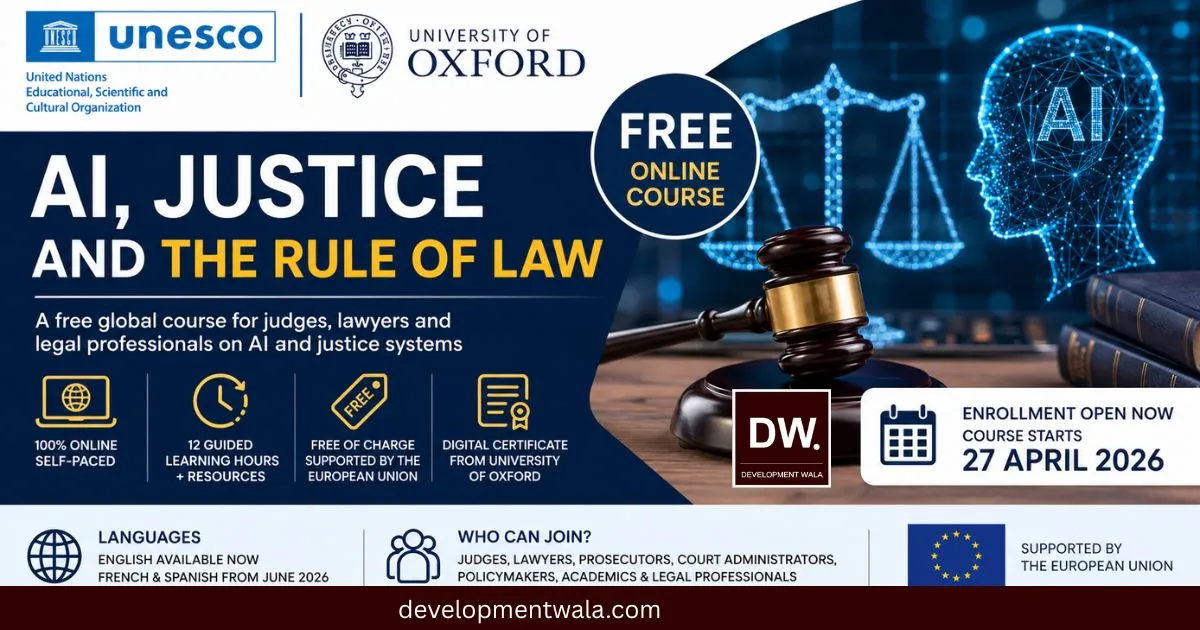
To address these emerging challenges, UNESCO and University of Oxford have launched a free global online course titled “AI, Justice and Rule of Law.” The course is designed to help judges, lawyers, prosecutors, policymakers, and legal professionals understand the ethical and legal implications of AI systems in courts and justice institutions.
The Massive Open Online Course, also known as a MOOC, is being offered free of cost and is supported by the European Union. It aims to equip judicial actors worldwide with practical tools and frameworks to evaluate AI technologies in line with human rights standards and the rule of law.
The launch of this course marks an important step in strengthening global judicial capacity in the age of artificial intelligence. As AI becomes increasingly embedded in governance and public institutions, legal professionals must develop the skills and knowledge needed to responsibly engage with these technologies.
According to UNESCO, cases involving AI are no longer theoretical. Courts across the world are already dealing with AI related disputes and evidence generated by automated systems. This course seeks to ensure that justice professionals are prepared for this rapidly changing landscape.
About the AI, Justice and Rule of Law Course
The AI, Justice and Rule of Law course has been developed by UNESCO in partnership with several leading institutions within the University of Oxford, including the Saïd Business School, the Blavatnik School of Government, and the Faculty of Law.
The course provides practical guidance on how AI systems are being used in judicial contexts and how courts can evaluate these systems responsibly. Participants will learn about issues such as algorithmic bias, automated decision making, due process, judicial independence, transparency, and access to justice.
One of the most important features of the course is its practical and rights based approach. Rather than focusing only on technical concepts, the course emphasizes real world legal and ethical challenges related to AI in justice systems.
The course also introduces a pioneering AI and Rule of Law Checklist that helps legal professionals assess AI systems and outputs, including situations where AI generated evidence is presented in court proceedings.
Why This UNESCO AI Course Matters in 2026
Artificial Intelligence is no longer limited to technology companies or research laboratories. Governments, courts, law enforcement agencies, and public institutions are increasingly using AI systems for various administrative and legal functions.
This growing integration of AI creates both opportunities and risks.
On one hand, AI can improve efficiency, reduce case backlogs, support legal research, and expand access to justice. On the other hand, poorly designed or biased AI systems can threaten fairness, human rights, and judicial integrity.
This is why training judicial professionals on AI governance has become critical.
The UNESCO and Oxford course addresses some of the most urgent questions facing legal systems today, including:
How should courts assess AI generated evidence?
What safeguards are needed to prevent algorithmic bias?
How can judicial independence be protected in automated systems?
What are the risks of over reliance on AI tools?
How can AI support access to justice without undermining human rights?
The course helps participants critically evaluate these questions while developing a deeper understanding of the relationship between technology and the rule of law.
Key Details of the UNESCO and Oxford AI Course
| Feature | Details |
|---|---|
| Course Name | AI, Justice and Rule of Law |
| Organizers | UNESCO and University of Oxford |
| Course Type | Massive Open Online Course (MOOC) |
| Mode | Online and Self Paced |
| Duration | Approximately 12 guided learning hours |
| Cost | Free |
| Languages | English available now, French and Spanish from June 2026 |
| Certification | Digital Certificate from University of Oxford and UNESCO |
| Eligibility | Open to judicial and legal professionals worldwide |
| Supported By | European Union |
| Registration | Open now |
What Participants Will Learn
The course offers a comprehensive introduction to AI governance within judicial systems. Participants will explore both the opportunities and challenges associated with the use of AI in courts and tribunals.
Some of the major learning areas include:
AI and Judicial Decision Making
Participants will understand how AI systems influence legal decision making processes and how courts can responsibly assess automated outputs.
Human Rights and AI
The course explores how AI systems can affect privacy, equality, freedom from discrimination, and due process rights.
AI Bias and Accountability
Learners will examine the risks of biased algorithms and understand mechanisms for ensuring accountability and transparency.
AI Generated Evidence
The course discusses how courts can evaluate evidence produced or supported by AI systems.
Gender and Vulnerable Communities
Special attention is given to how AI systems may disproportionately affect women and marginalized communities.
Judicial Independence
Participants will learn how to preserve judicial autonomy while integrating technological innovation into court systems.
Rule of Law Frameworks
The course introduces practical tools and legal frameworks to ensure AI systems align with democratic principles and international human rights standards.
Who Can Apply for This Free AI Course?
One of the strengths of this UNESCO and Oxford course is its broad accessibility. The course is designed for a wide range of professionals working in legal and governance systems.
Eligible participants include:
Judges
Judges can gain practical insights into evaluating AI systems and ensuring fair trial rights in digital environments.
Lawyers and Legal Practitioners
Lawyers can better understand the implications of AI in litigation, evidence assessment, and legal accountability.
Prosecutors
Prosecutors can develop stronger frameworks for evaluating AI assisted investigations and evidence.
Court Administrators
Court officials involved in digital modernization and judicial reform can learn about ethical AI implementation.
Policymakers
Government officials and policymakers working on AI governance and justice reforms can benefit from the course.
Academics and Researchers
Researchers studying law, technology, public policy, or AI ethics can use the course to deepen their understanding.
Early Career Legal Professionals
Young professionals entering the legal sector can gain future ready knowledge about AI and justice systems.
Importantly, no technical or coding background is required. The course is designed to be accessible to non technical participants.
Certification from the University of Oxford
Participants who successfully complete the course will receive a digital Certificate of Completion issued in partnership with UNESCO and the University of Oxford.
The certificate includes recognition from:
• UNESCO
• Blavatnik School of Government
• Faculty of Law, University of Oxford
• Saïd Business School
This certification can strengthen professional credibility for individuals working in law, governance, public policy, human rights, and digital regulation.
In an era where AI governance skills are becoming increasingly valuable, such certifications can significantly enhance career prospects.
Global Importance of AI Governance in Courts
Across the world, courts are being asked to decide cases involving facial recognition systems, predictive policing algorithms, automated decision making tools, and AI generated evidence.
This creates a major challenge for judicial systems.
Many legal professionals currently lack formal training on how AI systems function or how they should be evaluated under existing legal frameworks.
The UNESCO and Oxford course seeks to bridge this gap by creating global institutional capacity for AI governance in justice systems.
According to UNESCO, whether AI strengthens or weakens the rule of law will depend heavily on how courts and legal institutions respond to these technologies.
This makes judicial education one of the most important investments in the future of democratic governance.
The Growing Demand for AI and Law Professionals
The launch of this course also reflects a broader global trend. There is increasing demand for professionals who understand both technology and legal systems.
Fields such as AI governance, digital rights, cyber law, algorithmic accountability, and technology policy are rapidly expanding.
Professionals with expertise in AI ethics and law are now being recruited by:
• International organizations
• Governments
• Human rights institutions
• Technology companies
• Public policy think tanks
• Courts and tribunals
• Academic institutions
This makes the UNESCO AI course highly relevant not only for judicial actors but also for students and young professionals interested in emerging careers in technology governance.
Why Development Sector Professionals Should Explore This Course
For professionals working in the development sector, understanding AI governance is becoming increasingly important.
Artificial intelligence is already influencing areas such as:
• Welfare delivery
• Social protection systems
• Refugee management
• Public service delivery
• Education technology
• Digital identity systems
• Humanitarian response
• Data governance
Development practitioners must therefore understand the ethical and human rights implications of AI systems.
This UNESCO and Oxford course offers valuable insights into how technology intersects with justice, governance, accountability, and human rights.
Students pursuing careers in international development, public policy, governance, or law can greatly benefit from this learning opportunity.
Course Format and Flexibility
The course is fully online and self paced, making it accessible for participants from around the world.
Learners can complete the modules according to their own schedule. The estimated guided learning time is around 12 hours, with additional optional resources for deeper exploration.
This flexible format is especially useful for working professionals who may not have the time to attend full time training programs.
The course is currently available in English, while French and Spanish editions are expected to launch in June 2026.
How to Register for the UNESCO AI and Rule of Law Course
Enrollment for the course is already open.
Interested participants can register through the official UNESCO website and begin learning online at their convenience.
Official Course Link: UNESCO AI and Rule of Law Course
Applicants are encouraged to register early due to the growing global interest in AI governance and judicial training.
Benefits of Taking This Free Online Course
There are several reasons why this course stands out among global AI and law programs.
Completely Free
The course is funded by UNESCO and supported by the European Union, making it accessible without financial barriers.
Global Recognition
Participants receive certification from globally respected institutions.
Flexible Learning
The self paced format allows professionals to learn according to their own schedule.
Human Rights Focus
The course emphasizes ethical and rights based AI governance rather than only technical concepts.
Career Relevance
AI governance skills are becoming increasingly important across law, policy, development, and governance sectors.
Practical Tools
Participants gain actionable frameworks such as the AI and Rule of Law Checklist for real world judicial contexts.
Future of AI and the Rule of Law
As AI technologies continue to evolve, legal systems worldwide will face increasingly complex challenges.
Questions around accountability, fairness, transparency, and democratic oversight will become central to governance systems.
Courts will play a critical role in shaping how societies regulate AI and protect human rights in digital environments.
Training judicial professionals is therefore essential for ensuring that technological innovation supports justice rather than undermining it.
The UNESCO and University of Oxford initiative represents an important step toward building globally informed, ethically grounded, and technologically aware justice systems.
Conclusion
The launch of the AI, Justice and Rule of Law course by UNESCO and the University of Oxford is a timely and significant initiative for the global legal and governance community.
As artificial intelligence becomes increasingly embedded in courts and public institutions, legal professionals must be prepared to evaluate these systems responsibly and ethically.
This free online course offers an excellent opportunity for judges, lawyers, policymakers, development practitioners, researchers, and students to build practical knowledge on AI governance, human rights, and judicial accountability.
With flexible learning, global certification, and expert led content, the course is likely to become one of the most important AI and law learning opportunities of 2026.
If you are interested in the future of justice, technology, governance, or human rights, this course is definitely worth exploring.
Enroll NowFollow us and stay updated on the latest Non-Profit / social work Jobs and opportunities
Follow Kumar Preetam Puri on Linkedin: https://www.linkedin.com/in/kumarpreetampuri/
Development Wala LinkedIn Page: https://www.linkedin.com/company/development-wala/
📲 WhatsApp channel: https://whatsapp.com/channel/0029VaCxEqA0G0XoVCQyUx38
Instagram: https://www.instagram.com/developmentwala_official/
Discover more from Development Wala
Subscribe to get the latest posts sent to your email.