
Introduction
What does development actually mean?
For decades, economists, sociologists, political scientists, anthropologists and development practitioners have debated this question. Is development mainly about economic growth? Is it about industrialization and modernization? Does development mean reducing poverty and inequality? Or should it be understood as expanding people’s freedom, capabilities, participation and quality of life?
There is no single answer.
Development studies emerged as an interdisciplinary field that brings together economics, sociology, political science, anthropology, geography, history and public policy. As a result, different development theories have developed to explain why some societies become wealthier and more industrialized, why poverty persists, how global power shapes development, and what a better development process might look like.
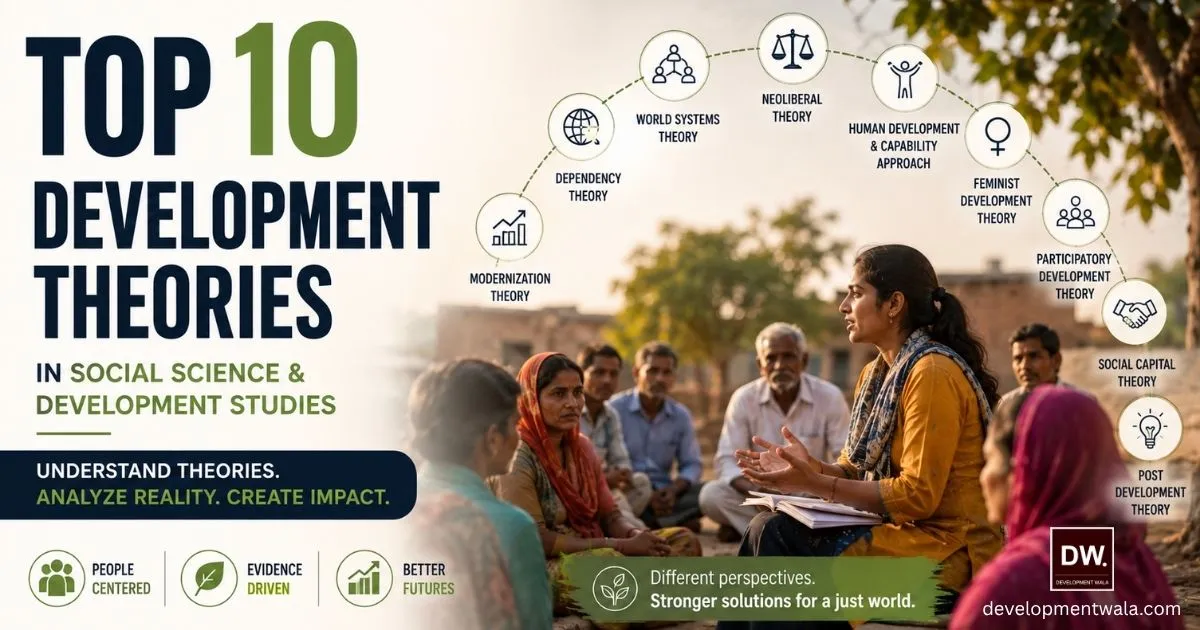
The material provided for this article highlights several major approaches including modernization theory, dependency theory, world systems theory, neoliberalism, post development theory, human development and capabilities, sustainable development, social capital, feminist development and participatory development.
However, it is important to distinguish between broad social theories and theories specifically concerned with development. Functionalism, structuralism, post structuralism and social action theory are highly influential traditions in social science, but they are broader theoretical perspectives rather than development theories in the narrow sense.
This article therefore focuses on ten of the most important theories and approaches that students of development studies, social sciences, international development and social policy should understand.
What Are Development Theories?
Development theories are frameworks used to explain how societies change economically, socially, politically and institutionally.
They help us ask questions such as:
Why are some countries richer than others?
Why does poverty persist despite economic growth?
What role should governments play in development?
How does global capitalism influence developing countries?
Should development be measured through GDP or human wellbeing?
Who should decide what development means?
How should communities participate in development programmes?
Different theories provide different answers to these questions. Some focus primarily on economic growth, while others emphasize global inequality, human freedom, gender, participation, institutions, culture or environmental sustainability.
Top 10 Development Theories
| Development theory | Main focus | Key thinkers | Central idea |
|---|---|---|---|
| Modernization Theory | Economic and social transformation | W. W. Rostow, Talcott Parsons | Societies move towards modern industrial development |
| Dependency Theory | Global inequality and exploitation | Andre Gunder Frank, Fernando Henrique Cardoso, Theotonio dos Santos | Underdevelopment is connected to unequal global economic relationships |
| World Systems Theory | Global capitalist system | Immanuel Wallerstein | Countries occupy different positions within the global economy |
| Neoliberal Development Theory | Markets and economic liberalization | Friedrich Hayek, Milton Friedman | Markets, competition and limited state intervention can promote development |
| Marxist and Structuralist Development Theory | Capital, class and structural transformation | Karl Marx, Raul Prebisch, Samir Amin | Development must be understood through economic structures and power |
| Human Development and Capability Approach | Human wellbeing and freedom | Amartya Sen, Mahbub ul Haq, Martha Nussbaum | Development means expanding people’s capabilities and choices |
| Feminist Development Theory | Gender and power | Ester Boserup, Diane Elson, Naila Kabeer | Development must address gender inequality and women’s agency |
| Participatory Development Theory | Community participation | Robert Chambers, Paulo Freire | People affected by development should participate in shaping it |
| Social Capital Theory | Networks, trust and collective action | Pierre Bourdieu, James Coleman, Robert Putnam | Social relationships can influence development outcomes |
| Post Development Theory | Alternatives to Western development | Arturo Escobar, Wolfgang Sachs, Gustavo Esteva | Development itself should be critically questioned and locally reimagined |
1. Modernization Theory
Modernization theory is one of the most influential classical theories of development.
It became particularly influential after the Second World War. The theory generally argues that societies move from traditional forms of social and economic organization towards modern industrial societies.
One of the best known thinkers associated with modernization is W. W. Rostow, whose stages of economic growth presented development as a sequence through which societies could move from traditional society towards mass consumption.
Modernization theory emphasizes factors such as industrialization, urbanization, technological progress, education, infrastructure, economic growth and changing social institutions.
In this perspective, countries experiencing poverty and low economic productivity are often understood as being earlier in a process of modernization.
Modernization theory has influenced international development policy, economic planning and development assistance for decades.
However, it has also faced substantial criticism.
Critics argue that it can be Eurocentric because it may treat the historical experience of Western industrialization as a universal model. It can also underestimate colonialism, international economic structures and differences between societies. OpenStax notes that critics have highlighted the ethnocentric assumptions involved in treating development as a common path for all countries. (OpenStax)
2. Dependency Theory
Dependency theory emerged partly as a response to modernization theory.
Instead of asking why poorer countries have failed to modernize internally, dependency theorists ask how relationships between wealthy and poorer countries have contributed to underdevelopment.
The theory became particularly influential in Latin American development debates.
Important thinkers associated with dependency theory include Andre Gunder Frank, Fernando Henrique Cardoso and Theotonio dos Santos.
The central argument is that developing countries do not exist separately from the global economy. Their economic conditions are shaped by relationships involving trade, investment, capital, technology and political power.
Andre Gunder Frank famously challenged the idea that underdevelopment represented an earlier stage of development. From this perspective, development and underdevelopment can be connected outcomes of the same global economic system.
Dependency theory therefore shifts attention from internal deficiencies towards structural relationships between powerful and less powerful economies.
Its influence remains important in discussions about colonialism, global inequality, international trade, debt, resource extraction and unequal economic relationships.
3. World Systems Theory
World systems theory takes the global perspective even further.
The approach is strongly associated with sociologist Immanuel Wallerstein. It views capitalism as a world economic system rather than simply a collection of individual national economies.
A central concept is the division of the global economy into core, semi peripheral and peripheral areas.
Core economies generally possess greater economic and political power and tend to dominate high value activities. Peripheral economies are more likely to depend on lower value production and the export of primary commodities. Semi peripheral economies occupy an intermediate position.
World systems theory helps explain why economic development cannot always be understood by studying individual countries in isolation.
It also provides a framework for examining global production chains, international trade and unequal relationships between different parts of the world economy.
Dependency and world systems theories became influential critiques of modernization theory from the late 1960s onwards. Academic research continues to use these approaches to understand global capitalism and international inequality. (OUP Academic)
4. Neoliberal Development Theory
Neoliberalism became particularly influential in development policy from the late twentieth century.
The approach emphasizes markets, private enterprise, competition, trade liberalization, deregulation and limited direct state intervention in economic activity.
Associated intellectual influences include Friedrich Hayek and Milton Friedman, although neoliberal development policy has taken different forms in different countries and institutions.
The basic argument is that markets can allocate resources efficiently and create incentives for investment, entrepreneurship and economic growth.
Neoliberal reforms have historically included privatization of state owned enterprises, reduction of trade barriers, financial liberalization and attempts to reduce government intervention in markets.
Supporters argue that competitive markets can improve efficiency and encourage economic dynamism.
Critics argue that market reforms can increase inequality, weaken public services or constrain the ability of governments to pursue social and industrial policy.
Understanding neoliberalism is particularly important for development students because many debates around structural adjustment, globalization, privatization and international financial institutions are connected to this approach.
5. Marxist and Structuralist Development Theory
Marxist approaches understand development through concepts such as capitalism, class relations, ownership, labour and accumulation.
Karl Marx’s work was not a development theory in the modern development studies sense, but Marxist thought has had enormous influence on how scholars understand economic transformation and inequality.
Marxist development perspectives ask who owns productive resources, who controls economic power and how wealth is distributed between different classes.
Structuralist development thinking also challenged the assumption that free markets automatically produce equal development outcomes.
Economist Raul Prebisch was particularly influential in arguing that the international economy could reproduce unequal relationships between industrialized countries and commodity exporting countries.
Later thinkers such as Samir Amin further developed critical approaches to global capitalism and unequal development.
This family of theories is useful for understanding industrialization, class inequality, labour relations, imperialism, capitalism and structural economic transformation.
Dependency and world systems theory also developed partly from broader Marxist and structural critiques of capitalism.
6. Human Development and the Capability Approach
The human development approach represents a major shift in the way development is understood.
Instead of treating economic growth as the final objective, it asks whether people are actually able to live lives they value.
Economist Amartya Sen’s capability approach is central to this perspective. The approach focuses on what people are genuinely able to do and to be, rather than simply the resources or income they possess. (Stanford Encyclopedia of Philosophy)
Mahbub ul Haq played a major role in translating these ideas into the human development approach used by the United Nations Development Programme.
The first Human Development Report was published in 1990 and placed people, opportunities and choices at the centre of development. (Human Development Reports)
This perspective considers areas such as health, education, income, political participation, freedom and access to opportunities.
For example, two people may have the same income but very different capabilities because of differences in health, education, discrimination, disability, infrastructure or social circumstances.
This is why human development cannot be reduced to GDP.
The capability approach has also been developed by scholars including Martha Nussbaum. It remains highly influential in discussions of poverty, inequality, gender, education, health and human wellbeing. (Stanford Encyclopedia of Philosophy)
7. Feminist Development Theory
Feminist development theory challenges development approaches that ignore gender relations and women’s experiences.
Traditional economic measures can overlook unpaid care work, household labour, unequal access to assets and differences in decision making power.
One important early contribution came from Ester Boserup, whose research highlighted the role of women in agricultural economies and showed how development processes could affect men and women differently.
Later feminist scholars including Diane Elson and Naila Kabeer expanded debates around gender, labour, institutions, power and women’s agency.
Feminist development approaches ask important questions.
Who benefits from development programmes?
Who performs unpaid work?
Who controls land and income?
Who makes household decisions?
Do women have access to education, employment and political participation?
Are development policies reproducing existing inequalities?
This perspective has significantly influenced gender responsive budgeting, women’s economic empowerment, gender mainstreaming and development policy.
For students interested in social development, gender studies, public policy, NGOs or international development, feminist development theory is particularly important.
8. Participatory Development Theory
Participatory development challenges top down approaches to development.
Instead of development organizations deciding what communities need and then implementing projects on their behalf, participatory approaches emphasize the involvement of local people in identifying problems, designing interventions, implementing programmes and evaluating outcomes.
Robert Chambers is one of the most influential thinkers associated with participatory development and Participatory Rural Appraisal.
The broader intellectual tradition is also connected with Paulo Freire’s emphasis on dialogue, critical consciousness and the agency of marginalized communities.
Participatory development is particularly relevant to NGOs, rural development programmes, community development and social mobilization.
The basic principle is simple.
People should not be treated merely as beneficiaries of development. They should have a meaningful role in shaping the decisions that affect their lives.
However, participation itself can become tokenistic if communities are consulted without having real decision making power.
Therefore, genuine participation requires attention to power, representation, inclusion and accountability.
9. Social Capital Theory
Social capital theory focuses on the role of relationships, networks, trust and social norms in shaping social and economic outcomes.
Important thinkers include Pierre Bourdieu, James Coleman and Robert Putnam, although they developed different understandings of social capital.
The central idea is that relationships between people can provide resources and create opportunities for cooperation.
For example, communities with strong networks and trust may find it easier to organize collective action, share information, respond to crises or manage common resources.
Social capital is particularly relevant to community development, local governance, civil society and collective action.
However, social networks are not automatically positive.
Networks can also exclude outsiders, reinforce elite power or reproduce inequality.
Therefore, development practitioners need to consider not only whether social capital exists but also who has access to it and how it is used.
10. Post Development Theory
Post development theory is one of the most radical critiques of conventional development thinking.
Instead of asking how developing countries can become more like Western industrialized countries, post development scholars question the assumption that Western economic and social models should define what development means.
Thinkers associated with post development include Arturo Escobar, Wolfgang Sachs and Gustavo Esteva.
The approach emphasizes cultural diversity, local knowledge, autonomy and alternatives to conventional development models.
It asks whether concepts such as progress, modernization, economic growth and poverty are always culturally neutral.
Post development thinking has also influenced debates around indigenous knowledge, local economies, community autonomy and alternative visions of wellbeing.
Critics argue that completely rejecting development can be difficult because communities often need better healthcare, education, infrastructure, employment and material living conditions.
Nevertheless, post development theory is valuable because it forces development practitioners to ask an important question: who gets to define development?
How Are These Development Theories Different?
The biggest difference between these theories is the way they explain the causes and objectives of development.
Modernization theory tends to emphasize internal transformation, industrialization and economic growth.
Dependency theory focuses on unequal relationships between powerful and poorer economies.
World systems theory examines the position of countries within the wider capitalist world economy.
Neoliberalism emphasizes markets and economic liberalization.
Marxist and structural approaches focus on capitalism, class and economic structures.
Human development focuses on people’s capabilities, choices and wellbeing.
Feminist development examines gender, power and inequality.
Participatory development focuses on community agency and decision making.
Social capital theory emphasizes relationships, networks and collective action.
Post development theory questions the assumptions behind conventional definitions of development.
No single theory can explain every development problem.
For example, poverty in a rural community could be examined through modernization theory by looking at infrastructure and productivity. A dependency perspective could examine international commodity markets. A feminist perspective could investigate women’s access to land and unpaid care work. A capability perspective could examine education, health and freedom. A participatory perspective could ask whether local people have influence over development decisions.
Using multiple theoretical perspectives can therefore produce a much richer understanding of development.
Development Theory and Sustainable Development
Sustainable development has become another major framework for contemporary development policy.
The United Nations defines sustainable development as development that meets present needs without compromising the ability of future generations to meet their own needs. It emphasizes the need to bring together economic growth, social inclusion and environmental protection. (United Nations)
Sustainable development is particularly important because traditional economic development can create environmental costs.
Rapid industrialization can generate employment and income but may also contribute to pollution, biodiversity loss, resource depletion and climate change.
This has made sustainability increasingly important for development planning.
The Sustainable Development Goals also demonstrate how contemporary development policy combines economic, social and environmental objectives.
Why Should Development Students Study These Theories?
Development theories are not simply academic concepts for examinations.
They influence how governments, international organizations, NGOs, researchers and development practitioners understand social problems.
A development practitioner working on poverty may unconsciously adopt a particular theory of development.
A policymaker promoting industrialization may draw on modernization or structuralist thinking.
An NGO emphasizing community participation may use participatory development principles.
A gender programme may draw on feminist development theory.
A human development programme may focus on capabilities, education, health and freedom rather than income alone.
Understanding these theories helps students identify the assumptions behind development policies and programmes.
It also helps professionals critically evaluate whether an intervention addresses the underlying causes of a problem or only its symptoms.
How Development Theories Evolved
The history of development theory can be understood as an ongoing debate.
Early modernization approaches often emphasized economic growth, industrialization and transition towards modern societies.
Dependency and world systems theorists challenged this perspective by highlighting colonial histories and unequal global economic relationships.
Marxist and structural approaches questioned the distribution of economic power.
Neoliberal approaches subsequently emphasized markets and liberalization.
Human development shifted attention towards people’s wellbeing, capabilities and choices.
Feminist approaches exposed the gendered dimensions of development.
Participatory approaches challenged top down decision making.
Post development scholars went further by questioning the meaning and purpose of development itself.
This evolution demonstrates that development studies is not a field with one universally accepted theory.
It is a field built around debate.
Frequently Asked Questions About Development Theories
What are the main theories of development?
Major theories include modernization theory, dependency theory, world systems theory, neoliberal development theory, Marxist and structuralist approaches, human development and the capability approach, feminist development theory, participatory development, social capital theory and post development theory.
Which development theory is most important?
There is no single most important development theory. Modernization, dependency and world systems theory are particularly important for understanding the historical development debate, while human development, feminist, participatory and post development approaches are highly relevant to contemporary social development.
What is modernization theory in development studies?
Modernization theory views development as a process of economic, technological, social and institutional transformation from traditional societies towards modern industrial societies.
What is dependency theory?
Dependency theory argues that poverty and underdevelopment can be connected to unequal economic and political relationships between powerful and poorer countries.
What is the capability approach?
The capability approach, pioneered by Amartya Sen, focuses on people’s real freedoms and opportunities to achieve the kinds of lives they value. (Stanford Encyclopedia of Philosophy)
Why is feminist development theory important?
Feminist development theory shows that development policies can affect women and men differently and highlights issues such as unpaid care work, access to resources, labour, power and decision making.
What is participatory development?
Participatory development emphasizes meaningful involvement of local communities in identifying problems, designing solutions, implementing projects and evaluating development interventions.
Is sustainable development a development theory?
Sustainable development is better understood as a broad development framework and policy paradigm rather than one single social science theory. It connects economic, social and environmental objectives.
Conclusion
Development is much more complicated than economic growth.
The major development theories discussed in this article offer different ways of understanding how societies change, why inequality persists and what development should ultimately achieve.
Modernization theory emphasizes transformation and industrialization. Dependency and world systems theory highlight global structures and unequal relationships. Neoliberalism emphasizes markets. Marxist and structural approaches examine capitalism and economic power. Human development and the capability approach put people and freedom at the centre. Feminist theory examines gender and power. Participatory development emphasizes community agency. Social capital highlights relationships and collective action. Post development theory questions conventional assumptions about what development itself means.
For students and professionals in development studies, social science, public policy, international development and the NGO sector, understanding these theories provides a foundation for analysing real world development problems.
The most useful approach is not necessarily to choose one theory and reject all others. Instead, learn what each theory explains, understand its assumptions, identify its limitations and consider how different perspectives can be combined to understand complex development challenges.
Theories of development ultimately help us ask better questions.
And in development work, asking the right question is often the first step towards finding a better solution.
References
- Rostow, W. W. (1960). The Stages of Economic Growth: A Non Communist Manifesto. Cambridge University Press.
https://books.google.com/books?id=9uQOAAAAQAAJ - Frank, A. G. (1967). Capitalism and Underdevelopment in Latin America. Monthly Review Press.
https://monthlyreview.org/product/capitalism-and-underdevelopment-in-latin-america/ - Wallerstein, I. (1974). The Modern World System. Academic Press.
https://www.ucpress.edu/book/9780520267576/the-modern-world-system-i - So, A. Y. (1990). Social Change and Development: Modernization, Dependency, and World System Theories. SAGE Publications.
https://us.sagepub.com/en-us/nam/social-change-and-development/book2948 - Kiely, R. (2017). “Dependency and World Systems Perspectives on Development.” Oxford Research Encyclopedia of International Studies.
https://academic.oup.com/edited-volume/61835/chapter/546990418 - Sen, A. (1999). Development as Freedom. Oxford University Press.
https://global.oup.com/academic/product/development-as-freedom-9780192893307 - United Nations Development Programme. Human Development.
https://hdr.undp.org/about/human-development - Stanford Encyclopedia of Philosophy. “The Capability Approach.”
https://plato.stanford.edu/entries/capability-approach/ - Sarker, D. (2006). “Development Theory and Gendered Approach to Development: A Review in the Third World Perspective.” Sociological Bulletin, 55(1), 45 to 66.
https://www.jstor.org/stable/23620522 - Chambers, R. (1997). Whose Reality Counts? Putting the First Last. Intermediate Technology Publications.
https://practicalactionpublishing.com/book/2354/whose-reality-counts - Escobar, A. (1995). Encountering Development: The Making and Unmaking of the Third World. Princeton University Press.
https://press.princeton.edu/books/paperback/9780691150451/encountering-development - United Nations. Sustainable Development Goals.
https://sdgs.un.org/goals - OpenStax. “Theoretical Perspectives on Global Stratification.” Introduction to Sociology 3e.
https://openstax.org/books/introduction-sociology-3e/pages/10-3-theoretical-perspectives-on-global-stratification
Follow us and stay updated on the latest Non-Profit / social work Jobs and opportunities
Follow Kumar Preetam Puri on Linkedin: https://www.linkedin.com/in/kumarpreetampuri/
Development Wala LinkedIn Page: https://www.linkedin.com/company/development-wala/
WhatsApp channel: https://whatsapp.com/channel/0029VaCxEqA0G0XoVCQyUx38
Instagram: https://www.instagram.com/developmentwala_official/
Discover more from Development Wala
Subscribe to get the latest posts sent to your email.