
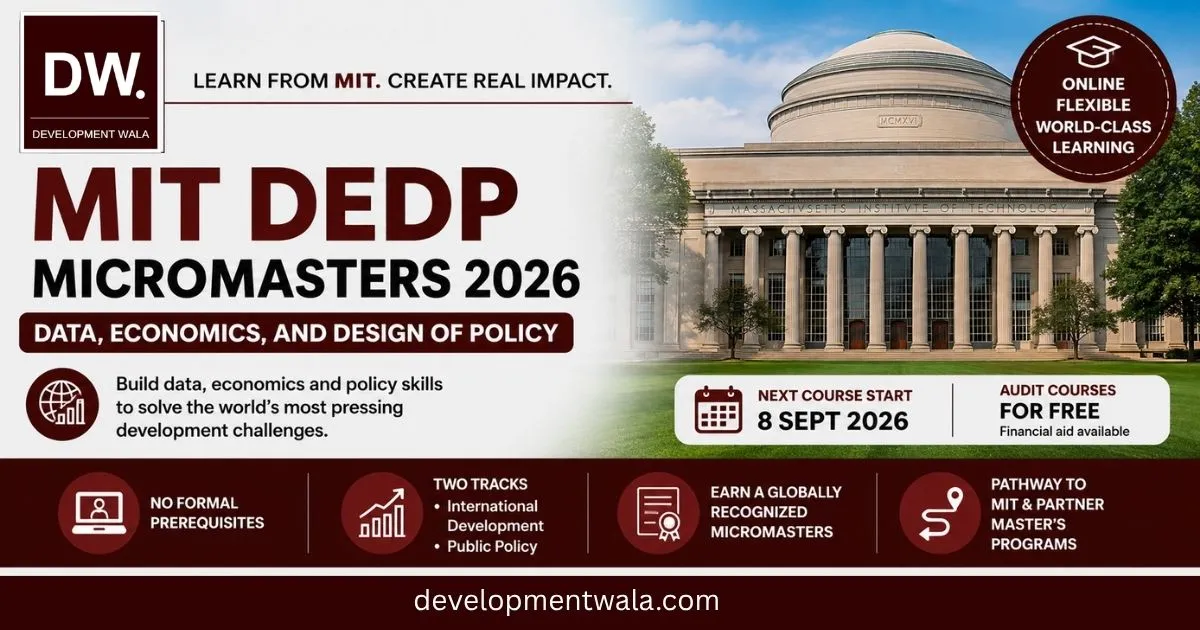
If you are interested in development economics, public policy, data analysis, poverty reduction, impact evaluation or evidence based policymaking, the MITx MicroMasters Program in Data, Economics, and Design of Policy, also known as DEDP, could be a valuable opportunity to explore.
Designed by the MIT Department of Economics and the Abdul Latif Jameel Poverty Action Lab, J PAL, the program combines graduate level economics with practical data and policy skills. It is designed for people who want to understand complex social problems and use evidence and data to develop better policies and programs.
The program is particularly relevant for students, researchers, NGO professionals, government professionals, development practitioners, policy professionals and anyone looking to build stronger quantitative skills for a career in the development sector.
One of the most attractive features is that the courses can be audited for free. Learners who want to earn the official MicroMasters credential can upgrade to the paid track and complete the required proctored examinations.
What is the MIT DEDP MicroMasters Program?
The Data, Economics, and Design of Policy MicroMasters is an online graduate level program developed by MIT’s Department of Economics and J PAL.
The program focuses on giving learners both theoretical knowledge and practical skills required to understand and address major economic and policy challenges.
Its curriculum includes economics, probability and statistics, data analysis and randomized evaluations. These tools are increasingly important across development organisations, governments, international agencies, foundations, research institutions and policy organisations.
The program is taught by leading economics faculty and researchers associated with MIT and J PAL. Faculty directors include Esther Duflo, Abhijit Banerjee, Sara Fisher Ellison and Benjamin Olken. Esther Duflo and Abhijit Banerjee are also recipients of the 2019 Nobel Prize in Economic Sciences.
The program has two major tracks:
- International Development
- Public Policy
This allows learners to select coursework aligned with their professional or academic interests.
MIT DEDP MicroMasters 2026 at a Glance
| Feature | Details |
|---|---|
| Program | MITx MicroMasters in Data, Economics, and Design of Policy |
| Institution | Massachusetts Institute of Technology |
| Designed by | MIT Department of Economics and J PAL |
| Format | Online |
| Tracks | International Development and Public Policy |
| Core courses | 3 |
| Electives required | 2 |
| Advanced elective | At least 1 required |
| Audit option | Free |
| Paid course price | $250 to $1,000 per course depending on household income |
| Financial assistance | Available |
| Formal prerequisites | None |
| Next listed course start | September 8, 2026 |
| Following listed course start | January 19, 2027 |
| Pathway | Potential pathway to master’s programs |
| Official website | MIT DEDP MicroMasters |
The information above is based on the current MIT DEDP program information.
Who Can Apply for the MIT DEDP MicroMasters?
One of the strongest features of the MIT DEDP MicroMasters is its accessibility.
MIT states that the courses are open to anyone with access to a computer and the internet, and there are no formal prerequisites for enrolling in the courses.
This means that you do not necessarily need to already hold a degree in economics to explore the program.
The program identifies several groups who may benefit from it.
Students
Students interested in development economics, public policy, political science or related graduate programs can use the MicroMasters to develop relevant academic and quantitative skills.
It can also help learners understand whether advanced economics and policy analysis is the right direction for their future studies.
Development Sector Professionals
Professionals working in NGOs, governments, international aid organisations, foundations and other development organisations can use the program to strengthen their understanding of economics, data and policy evaluation.
This can be especially relevant for professionals working in monitoring and evaluation, research, policy, program management, impact assessment and development consulting.
Researchers and Evaluators
Researchers and evaluators can use the coursework to strengthen their understanding of data driven approaches to social programs and development interventions.
Academics and Educators
The program can also be relevant for instructors and professors looking to incorporate modern economic and policy concepts into their teaching.
Lifelong Learners
You do not have to be working in the development sector to benefit from the program. MIT also lists lifelong learners among its potential audience.
What Will You Study?
The DEDP curriculum combines economics, statistics, data analysis and policy evaluation.
The MicroMasters credential requires learners to successfully complete five courses, consisting of three core courses and two electives from their selected track. At least one of the electives must be an advanced elective.
Core Courses
The three core courses currently listed by the program are:
1. Microeconomics
This course provides the foundation in microeconomic thinking and helps learners understand how individuals, households, firms and markets make decisions.
2. Designing and Running Randomized Evaluations
Randomized evaluations are an important tool for understanding whether social and development programs actually work.
This course focuses on the design and implementation of randomized evaluations and is particularly relevant for people interested in impact evaluation and evidence based policymaking.
3. Data Analysis for Social Scientists
Data analysis is increasingly central to research, development programs and public policy.
This course focuses on developing the analytical skills required by social scientists working with data.
The three core courses are currently scheduled to start on September 8, 2026.
International Development Track
The International Development Track is particularly relevant for people interested in poverty, inequality, development economics and social policy in low and middle income countries.
MIT describes the track as focusing on development challenges including decisions made by low income households, microfinance and the relationship between economic development and political institutions.
Learners need to complete two electives from the available International Development options.
The currently listed options include:
The Challenges of Global Poverty
This introductory course explores major questions surrounding poverty and development.
Foundations of Development Policy: Advanced Development Economics
This advanced course provides deeper exposure to development economics and policy.
Political Economy and Economic Development
This advanced course examines the relationship between political institutions, economic systems and development.
The first two listed International Development electives start on September 8, 2026, while Political Economy and Economic Development is listed to start on May 11, 2027.
Public Policy Track
The Public Policy Track focuses on poverty alleviation and policy challenges in the United States and other high income countries.
The curriculum includes issues such as minimum wage, consumer welfare, trade and immigration.
The currently listed electives include:
Good Economics for Hard Times
An introductory course exploring economic and policy questions.
Microeconomic Theory and Public Policy
An advanced course connecting microeconomic theory with public policy.
Energy Economics and Policy
An introductory course focused on economic and policy questions surrounding energy.
Frontiers of Applied Economics
An advanced course covering applied economics.
Learners need to complete two Public Policy electives, with at least one being an advanced elective.
How Much Does the MIT DEDP MicroMasters Cost?
This is one of the most important points for prospective learners.
The DEDP courses can be audited for free.
However, learners who want to earn the verified certificates and ultimately complete the requirements for the MicroMasters credential need to take the relevant proctored examinations through the paid option.
The course price depends on household income.
| Annual Household Income | Course Price |
|---|---|
| $0 to $25,000 | $250 per course |
| Over $25,000 to $50,000 | $350 per course |
| Over $50,000 to $75,000 | $500 per course |
| Over $75,000 | $1,000 per course |
MIT also states that a limited number of $100 course price coupons are available to learners with annual income below $10,000. These are distributed through a lottery system each term. Learners who are not selected retain the $250 course price under the applicable pricing tier. (micromasters.mit.edu)
Financial assistance is also available, and MIT advises learners to request it when enrolling in a course on MITx Online. (micromasters.mit.edu)
Is the MIT DEDP MicroMasters Free?
The answer depends on what you mean by free.
You can audit the DEDP courses for free, which allows learners to access the course content without paying the verified course fee.
However, completing the requirements for the official MicroMasters credential involves passing the required proctored examinations through the paid track.
Therefore, students who have limited financial resources can still explore the course material without immediately paying.
What Are the Benefits of the MIT DEDP MicroMasters?
Learn From MIT Faculty
The program provides access to graduate level coursework developed by MIT’s Department of Economics and J PAL.
The faculty and researchers associated with the program include leading names in economics and development economics.
Build Data and Economics Skills
Development sector professionals increasingly need the ability to understand data, evaluate programs and interpret evidence.
DEDP brings these skills together through economics, statistics, data analysis and randomized evaluation.
Study Online
The program provides flexibility for learners who may already be studying or working.
MIT states that courses are offered between one and three times per year, allowing learners to spread coursework and examinations according to their schedules.
No Formal Prerequisites
Learners do not need to meet formal prerequisites to enrol in the courses.
However, because the courses are graduate level and involve economics, mathematics and data analysis, prospective learners should realistically assess their preparedness before committing to the full credential.
Potential Master’s Pathway
The MicroMasters credential can provide a pathway toward master’s level study.
Learners who successfully complete the credential are eligible to apply to MIT’s Master of Applied Science in Data, Economics, and Design of Policy, as well as certain pathway universities and participating universities in J PAL’s Alliance for Data, Evaluation, and Policy Training.
Importantly, earning the MicroMasters does not automatically guarantee admission to a master’s program. Learners still need to satisfy the relevant admission requirements.
Can the MIT DEDP MicroMasters Lead to a Master’s Degree?
Yes, the MicroMasters can serve as a pathway to master’s level programs.
MIT’s own DEDP master’s program requires applicants to first successfully complete the online DEDP MicroMasters credential.
For students admitted to the MIT master’s program, the MicroMasters coursework can provide substantial academic credit.
The MIT master’s program combines online coursework with a residential component at MIT and an approved capstone project. The program page states that admitted learners receive 48 academic units for their MicroMasters coursework, with the remaining requirements completed through the residential semester and capstone.
The DEDP MicroMasters also has pathway arrangements with other universities. The exact amount of credit and admission conditions vary by institution.
Upcoming MIT DEDP Course Dates
For learners planning their applications and study schedules, MIT currently lists the following future course dates:
Summer 2026: May 12, 2026
Fall 2026: September 8, 2026
Spring 2027: January 19, 2027
Specific courses may have different starting dates, so applicants should check the official MIT DEDP course listings before enrolling.
How to Apply for the MIT DEDP MicroMasters
The application process is relatively straightforward because the MicroMasters courses do not have formal prerequisites.
Step 1: Choose Your Track
First decide whether your interests align more closely with:
International Development
or
Public Policy
If you are interested in poverty, development economics, international development and challenges in low and middle income countries, the International Development Track may be the more relevant choice.
If your interests are primarily related to public policy and economic policy challenges in high income countries, the Public Policy Track may be more suitable.
Step 2: Explore the Courses
Review the core courses and electives available under your selected track.
Remember that the MicroMasters credential requires three core courses and two electives, with at least one advanced elective.
Step 3: Enrol Through MITx Online
You can enrol in the relevant courses through MIT’s online learning platform.
Learners can begin by auditing courses for free or choose the verified option if they intend to work toward the credential.
Step 4: Request Financial Assistance if Required
If the course price is difficult to afford, MIT allows learners to request financial assistance during enrolment.
The final course price is based on the applicable income based pricing structure.
Step 5: Complete the Required Courses and Exams
To earn the MicroMasters credential, you need to successfully pass five courses and complete the required proctored examination for each course.
The five courses must consist of the three core courses and two electives from your selected track. At least one elective must be advanced.
Who Should Consider This Opportunity?
The MIT DEDP MicroMasters could be particularly valuable for development sector professionals who want to strengthen their quantitative and analytical capabilities.
It may be useful for people working in:
NGOs
Government programs
International development
Monitoring and evaluation
Research
Public policy
Impact evaluation
Development consulting
Social impact organisations
Foundations
International aid agencies
For students, the program can also provide exposure to graduate level economics and policy analysis before committing to a full master’s degree.
Tips Before Enrolling
Understand the Level of the Course
The absence of formal prerequisites does not mean the coursework is easy.
MIT describes the program as rigorous and states that its courses offer the same challenge as residential MIT classes while combining theoretical tools with practical skill building.
Plan Your Time
Do not underestimate the workload.
If you are working full time, consider spreading your coursework across different course offerings instead of attempting everything simultaneously.
Choose Your Track Carefully
Think about your long term career goals before selecting your electives.
If you want to work primarily in international development, poverty reduction and development economics, the International Development Track may align more closely with your goals.
Explore the Free Audit Option First
If you are unsure whether the program is right for you, auditing a course can be a useful way to understand the teaching style, workload and academic level before paying for the verified option.
Think Beyond the Certificate
The real value of the program may not simply be the credential.
The economics, data analysis and evaluation skills developed through the coursework can potentially be applied to real world development and policy problems.
Frequently Asked Questions
Is the MIT DEDP MicroMasters free?
The courses can be audited for free. Learners pursuing the verified certificates and MicroMasters credential need to pay for the applicable proctored examination option.
Does MIT DEDP have an age limit?
The program information does not specify an age limit. It states that the courses are open to anyone with computer and internet access and have no formal prerequisites.
Do I need an economics degree?
No formal prerequisites are listed by MIT. However, the program is graduate level and includes economics, mathematics, statistics and data analysis, so learners should be prepared for rigorous coursework.
Can NGO professionals apply?
Yes. MIT specifically identifies mid career professionals working in governments, NGOs, international aid agencies, foundations and other development sector organisations among the potential learners for the program.
Can the MicroMasters help with a master’s degree?
Yes. The credential provides a pathway to apply to MIT’s Master of Applied Science in Data, Economics, and Design of Policy and can provide academic credit at certain pathway universities. Admission is not automatic and depends on each institution’s requirements. (micromasters.mit.edu)
When does the next DEDP course start?
MIT currently lists September 8, 2026 as the next major course start date, followed by January 19, 2027. Individual courses can have different start dates. (micromasters.mit.edu)
How to Apply
If you are interested in building advanced skills in economics, data analysis, development policy and evidence based policymaking, this MIT opportunity is worth exploring.
Apply here:
https://docs.google.com/forms/d/e/1FAIpQLScn1QRY4VPxJpH0ZCLFrRyOKZ3TYa_RrkV8wRf8gsxpB7AeeA/viewform
For the latest course availability and official program information, always verify details directly with MIT before enrolling. (micromasters.mit.edu)
Conclusion
The MITx Data, Economics, and Design of Policy MicroMasters is an opportunity for learners who want to understand development and public policy through a rigorous, evidence based approach.
With courses covering microeconomics, data analysis and randomized evaluations, alongside specialised electives in international development and public policy, the program can help students and professionals develop skills that are increasingly valuable across the development sector.
The combination of online flexibility, free auditing, income based pricing, financial assistance and potential master’s pathways makes the program particularly interesting for development sector aspirants.
If you are serious about a career in development economics, public policy, research, monitoring and evaluation or evidence based policymaking, explore the program and see whether it fits your academic and professional goals.
Follow Development Wala for more scholarships, fellowships, courses, jobs and development sector opportunities.
Website: https://developmentwala.com
LinkedIn: https://www.linkedin.com/company/development-wala/
Instagram: https://www.instagram.com/developmentwala_official/
YouTube: https://www.youtube.com/@DevelopmentWalaofficial
Facebook: https://www.facebook.com/thedevelopmentwala
WhatsApp Channel: https://whatsapp.com/channel/0029Va4n8zQ9sBIx6GmZ4N2C
Tags: MIT MicroMasters, MIT DEDP, Data Economics and Design of Policy, MITx, development economics, public policy, development sector, online courses, economics courses, policy courses, international development, impact evaluation, data analysis, J PAL, career opportunities, Development Wala
Discover more from Development Wala
Subscribe to get the latest posts sent to your email.