
Introduction
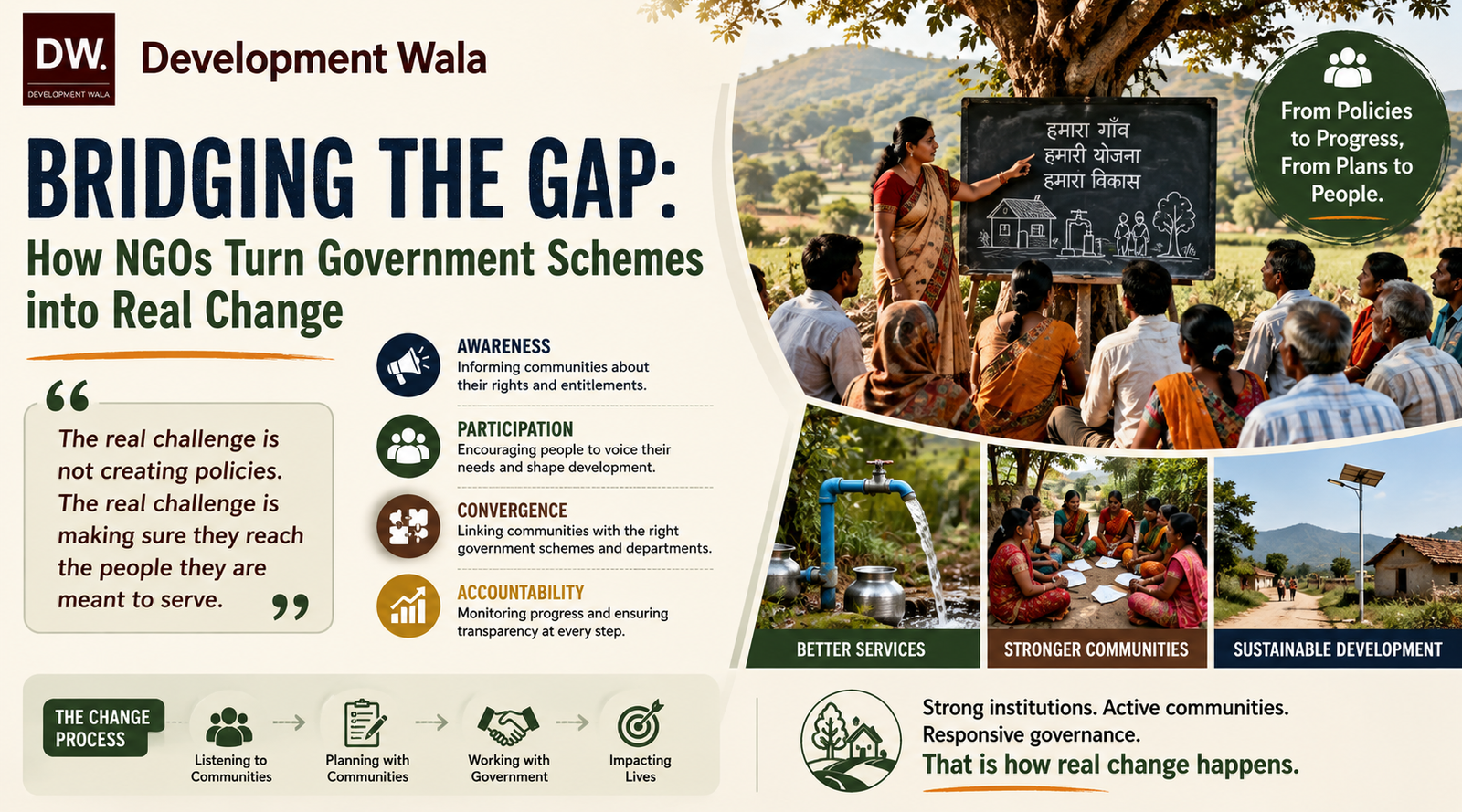
The real challenge is not creating policies. The real challenge is making sure they reach the people they are meant to serve.
Across rural India, there are countless villages where daily life is shaped by geographical isolation, limited infrastructure, and restricted access to government services. In many communities, the nearest market may be several kilometres away, mobile connectivity may be unreliable, and government offices may feel distant not only because of location but also because of accessibility.
When communities are asked about the challenges they face, the responses are remarkably similar across regions. Farmers speak about inadequate irrigation. Women highlight the need for safe drinking water. Villages identify the absence of streetlights and better roads. Eligible families continue to wait for housing assistance. Many households depend on seasonal migration because local livelihood opportunities remain limited.
Many of these challenges already have government schemes designed to address them. Programmes exist for rural housing, employment generation, water conservation, livelihood promotion, sanitation, and infrastructure development.
However, many eligible households remain unaware of these opportunities or are uncertain about how to access them. Some find administrative procedures difficult to navigate, while others lose confidence after receiving little follow up on their applications.
This reflects one of the most significant challenges in rural development today. The issue is often not the absence of government programmes, but the gap between policies designed at the institutional level and the realities experienced by communities.
This gap is not merely geographical. It can be informational, administrative, social, and sometimes cultural.
Bridging this divide is one of the important roles played by non governmental organisations and other social sector organisations. Rather than replacing government systems, NGOs can strengthen the connection between communities and public institutions, helping ensure that development moves beyond policy documents and reaches people’s everyday lives.
India Has No Shortage of Government Schemes
India has introduced numerous welfare schemes over the years to improve the lives of its citizens. From employment through the Mahatma Gandhi National Rural Employment Guarantee Act to rural housing under Pradhan Mantri Awaas Yojana Gramin and livelihood promotion through the National Rural Livelihoods Mission, these programmes aim to reduce poverty, strengthen rural infrastructure, and improve quality of life.
On paper, these schemes are comprehensive. They identify beneficiaries, allocate budgets, define responsibilities, and establish implementation mechanisms.
Yet, despite these efforts, many villages continue to struggle with basic services and economic opportunities.
This raises an important question.
If government schemes already exist, why do so many communities remain underserved?
The answer is more complex than simply saying that implementation is weak.
Development is rarely a straight line. Between policy design and actual implementation, there are several layers of administration, communication, documentation, verification, and community engagement. At each stage, challenges can emerge.
Why Do Rural Communities Struggle to Access Government Schemes?
Lack of Awareness
One of the most common barriers is limited awareness.
Many rural households are unaware of the government schemes they may be eligible for. Even when people know that a programme exists, they may not understand the eligibility criteria, documents required, application process, or where they need to apply.
Information can remain concentrated within government offices, official notices, websites, or digital platforms that may not be easily accessible to everyone.
For households with limited digital access or low familiarity with administrative systems, simply knowing that a scheme exists does not necessarily mean they can benefit from it.
This is where community based organisations can play an important role by helping people understand available programmes and the processes involved.
Complex Administrative Processes
Government systems need procedures to maintain accountability and ensure that public resources reach eligible beneficiaries. However, these procedures can sometimes become difficult for people living in remote areas.
Applications may require documents, verification, approvals, bank accounts, identification records, and coordination between different offices.
For someone living in a remote village, travelling to a block office can mean losing an entire day’s wages.
For elderly people, persons with disabilities, women with household responsibilities, or people with limited mobility, these administrative requirements can become even more challenging.
NGOs and community organisations can help people understand these processes and connect them with the appropriate institutions.
Geographical Isolation
India’s geographical diversity also creates implementation challenges.
Villages located in forests, hilly regions, remote tribal areas, or geographically isolated locations can be harder to reach. Poor roads, limited public transport, and weak digital connectivity can affect both service delivery and communication.
A government scheme launched at the national level may take considerable time before information reaches communities in remote areas.
Local organisations that already have relationships within these communities can help improve communication and create stronger links between people and public institutions.
Social and Cultural Barriers
Development is not only about infrastructure and finance. It is also about people, relationships, participation, and trust.
In some communities, women may hesitate to participate in public meetings. Marginalised groups may feel excluded from decision making. Language differences can also create communication challenges, particularly in areas where local dialects are widely spoken.
Government officials may visit communities periodically, but building trust often takes time.
Communities are more likely to participate when they feel that their experiences are being heard and respected.
Different Community Priorities
Sometimes the priorities of communities differ from what officials assume they need.
A government department may focus on infrastructure development, while villagers may consider irrigation, drinking water, livelihood opportunities, or access to markets more urgent.
Without meaningful consultation, development interventions risk addressing visible problems without understanding the underlying needs of communities.
This is why listening becomes just as important as planning.
The Role of NGOs in Rural Development
This is where NGOs can become important actors in rural development.
Their role is not to replace the government. Instead, they can strengthen the connection between government institutions and communities.
Many NGOs spend significant periods working directly with communities. They build relationships, understand local contexts, facilitate community meetings, support local institutions, and help people engage with government programmes.
Their work can go beyond implementing individual projects.
NGOs can help people understand their rights and entitlements, organise community discussions, identify priorities, participate in planning processes, and communicate with government departments.
Rather than deciding what a village needs, effective community development approaches begin by asking people what matters to them.
This shifts development from being for the people to being with the people.
Listening Before Acting
One of the strengths of community based organisations is their ability to begin with listening.
Before proposing solutions, they can spend time understanding a village, its resources, challenges, social dynamics, and aspirations.
This may involve household visits, meetings with women’s Self Help Groups, discussions with farmers, youth groups, Panchayat representatives, and village elders.
These conversations can reveal issues that statistics alone cannot capture.
For example, government data may show that a village has access to a water source. Community discussions might reveal that the source dries up during summer, is too far away for elderly people, or becomes contaminated during the rainy season.
Similarly, official records may indicate that livelihood opportunities exist, while villagers may explain that seasonal migration continues because local employment remains irregular.
This deeper understanding allows development organisations to identify not only what is missing but also what matters most to the community.
Development becomes more meaningful when it begins with people’s lived experiences rather than assumptions.
Turning Community Voices into Development Plans
Listening to communities is only the first step.
The next challenge is transforming those conversations into action.
NGOs can help communities organise their needs, prioritise them, and connect them with the relevant government departments and programmes.
In many villages, people know what they need but may not know how to present those needs within government planning processes.
NGOs can support participatory planning through village meetings, Gram Sabhas, household surveys, and discussions with Self Help Groups.
For example, a village may identify drinking water, irrigation, road connectivity, and livelihood opportunities as its most urgent priorities.
Instead of these demands remaining informal conversations, they can be documented, discussed, prioritised, and incorporated into appropriate village level planning processes.
This approach can strengthen community ownership.
Development is no longer something that simply happens to people. It becomes something they actively participate in shaping.
Strengthening the Link Between Government Departments
One of the major challenges in rural development is that different government departments often work within their own areas of responsibility.
However, the needs of a village rarely fit into one department.
A drinking water issue may involve the Rural Water Supply system. A farm pond may require support through MGNREGA. Livelihood promotion may come under the National Rural Livelihoods Mission, while rural housing falls under PMAY Gramin.
Without coordination, communities may have to approach multiple offices, submit documents repeatedly, and navigate complicated administrative systems.
NGOs can help simplify this process by acting as facilitators.
They can coordinate with Panchayats, block officials, and relevant government departments to ensure that community priorities are connected with appropriate programmes.
This approach is often described as convergence.
Convergence allows different schemes and departments to contribute towards addressing interconnected community needs rather than treating every development challenge as an isolated issue.
Empowering Communities to Lead
Perhaps one of the most meaningful contributions of NGOs is not simply the number of projects they implement but the confidence they help build within communities.
Real development happens when people begin to believe that their voices matter.
Across rural India, civil society organisations have supported women’s participation in Gram Sabha meetings, strengthened Self Help Groups, encouraged youth leadership, and helped marginalised communities engage with public institutions.
The objective should not be to speak on behalf of communities permanently.
Instead, NGOs can create spaces where communities develop the confidence and capacity to speak for themselves.
When women who were initially hesitant to speak in public begin presenting their village priorities before government officials, the change represents more than participation in a meeting.
It represents a shift in confidence, participation, and ownership.
When communities become active participants rather than passive beneficiaries, development programmes can become more responsive and sustainable.
Ensuring Accountability
Bridging the gap does not end when a government scheme is approved.
A sanctioned project still needs to be implemented, monitored, and evaluated.
NGOs and community organisations can support people in tracking whether promised services are actually delivered.
They can help communities understand their entitlements, monitor progress, document challenges, and raise concerns when implementation does not meet expectations.
This can contribute to greater transparency and accountability within the development process.
Community participation is particularly important because people living in a village are often best placed to understand whether a project is actually addressing their needs.
When citizens have access to information and meaningful opportunities to participate, they can become important partners in improving public service delivery.
How NGOs Support Different Areas of Rural Development
The role of NGOs in rural development can extend across several interconnected areas.
| Area of Development | How NGOs Can Support Communities |
|---|---|
| Government schemes | Awareness, eligibility guidance, documentation support, and institutional linkages |
| Rural livelihoods | Skill development, Self Help Groups, entrepreneurship, and livelihood planning |
| Women empowerment | Leadership development, collective action, and participation in local governance |
| Water and sanitation | Community awareness, local planning, and monitoring |
| Rural housing | Awareness about housing schemes and support in navigating processes |
| Employment | Awareness of employment programmes and support for accessing entitlements |
| Local governance | Participation in Gram Sabha and community planning |
| Social protection | Connecting eligible households with relevant welfare programmes |
| Community monitoring | Tracking implementation and raising concerns with authorities |
| Youth development | Skills, leadership opportunities, and community engagement |
The specific role of an NGO varies according to the needs of the community, the organisation’s expertise, and the local institutional environment.
Challenges Faced by NGOs
Despite their important role, NGOs also face significant challenges.
Many organisations operate with limited financial resources and small teams while working across large geographical areas.
Remote locations, difficult terrain, language diversity, limited infrastructure, and changing government guidelines can make implementation more complex.
Building trust within communities also takes time, particularly in places where previous development interventions have not met expectations.
Another challenge is sustainability.
An NGO may successfully implement a project, but lasting development requires local institutions and communities to continue the work after external support reduces.
This is why capacity building and community ownership are as important as project implementation.
NGOs also cannot solve every development challenge on their own.
Sustainable rural development requires collaboration between government institutions, Panchayati Raj Institutions, civil society organisations, community groups, and citizens.
Each stakeholder has a different role.
Government and NGOs Need Each Other
The relationship between government and NGOs should not be understood as a competition.
Government institutions have scale, public resources, policy authority, and formal administrative systems.
NGOs often bring local relationships, community trust, flexibility, and grassroots experience.
When these strengths are combined, development programmes can become more responsive to local realities.
The government can provide the institutional framework and resources, while NGOs can help strengthen community engagement and communication.
Communities, meanwhile, bring knowledge of their own priorities, experiences, resources, and challenges.
This creates a three way relationship between government institutions, civil society, and communities.
The strongest development outcomes are possible when all three work together.
The Future of Community Led Rural Development
India’s rural development landscape is changing.
Digital platforms are making information more accessible. Self Help Groups are becoming important institutions for women’s economic participation. Panchayats are increasingly involved in local planning, while civil society organisations are experimenting with new approaches to community engagement.
However, technology alone cannot solve every access problem.
A person may have access to a smartphone but still struggle to understand a government application.
A scheme may be available online but still remain inaccessible to someone who has limited digital literacy.
This is why human relationships remain important.
Technology can improve access to information, but community institutions and trusted organisations can help people understand, interpret, and act on that information.
The future of rural development therefore requires both stronger public systems and stronger community participation.
Frequently Asked Questions
What is the role of NGOs in rural development?
NGOs can support rural development by connecting communities with government schemes, strengthening local institutions, facilitating community participation, supporting livelihoods, promoting awareness, and helping citizens engage with public institutions.
How do NGOs help people access government schemes?
NGOs can create awareness about government programmes, explain eligibility requirements, support documentation and application processes, facilitate communication with government departments, and help communities understand their entitlements.
Why are government schemes sometimes unable to reach rural communities?
Several factors can contribute to limited access, including lack of awareness, administrative complexity, geographical isolation, limited digital connectivity, social barriers, and insufficient communication between institutions and communities.
What is community participation in rural development?
Community participation means involving local people in identifying problems, setting priorities, planning interventions, implementing activities, and monitoring development outcomes.
Can NGOs replace the government in rural development?
No. NGOs cannot replace government institutions. Their role is better understood as complementary. They can strengthen communication, participation, local capacity, and connections between communities and government systems.
Why is convergence important in rural development?
Convergence is important because rural development challenges are interconnected. Different government schemes and departments can work together to address multiple dimensions of a community’s needs.
References
- Ministry of Rural Development, Government of India. Mahatma Gandhi National Rural Employment Guarantee Act. MGNREGA Official Website
- Ministry of Rural Development, Government of India. Pradhan Mantri Awaas Yojana Gramin. PMAY Gramin Official Website
- Ministry of Rural Development, Government of India. Deendayal Antyodaya Yojana National Rural Livelihoods Mission. DAY NRLM Official Website
- Ministry of Jal Shakti, Government of India. Jal Jeevan Mission. Jal Jeevan Mission Official Website
- Ministry of Panchayati Raj, Government of India. Gram Panchayat Development Planning. Ministry of Panchayati Raj
- NITI Aayog, Government of India. Sustainable Development Goals and development monitoring. NITI Aayog
- World Bank. World Development Report 2017: Governance and the Law. World Development Report 2017
- United Nations Development Programme. Human Development Reports. UNDP Human Development Reports
Conclusion
Government schemes have the potential to transform millions of lives. However, policies alone cannot create development unless they reach the people they are intended to serve.
This is where NGOs can make a meaningful difference.
They can translate policies into community level action, simplify complex systems, strengthen local institutions, encourage citizen participation, and help ensure that development planning reflects the realities of people’s lives.
The true measure of development is not only the number of schemes launched or funds allocated.
It is whether a farmer gains access to irrigation, whether a woman confidently raises her voice in the Gram Sabha, whether a family receives a safe home, whether a community gets reliable drinking water, or whether a young person no longer needs to migrate because meaningful livelihood opportunities exist locally.
NGOs do not replace the government. They can strengthen the connection between the state and its citizens.
By building trust, encouraging participation, supporting local institutions, and facilitating collaboration, NGOs can help ensure that development is not only planned well but also experienced by the people it is intended to benefit.
Bridging the gap between government schemes and community needs is therefore not simply about delivering services.
It is about creating a development process where people have the opportunity to participate, contribute, and benefit.
That is the foundation of inclusive and sustainable rural development.
Follow Development Wala
Stay connected with Development Wala for more informative content on rural development, government schemes, NGOs, social impact, careers, scholarships, fellowships, and opportunities in the development sector.
Follow us on social media for regular updates, useful resources, and opportunities.
Instagram: https://www.instagram.com/developmentwala_official
LinkedIn: https://www.linkedin.com/company/developmentwala
Website: https://developmentwala.com
Discover more from Development Wala
Subscribe to get the latest posts sent to your email.