
India’s rural future is standing at a critical crossroads.
On one side lies an agriculture system dependent on chemicals, monocropping, rising input costs, declining soil fertility, and increasing ecological stress. On the other side is a growing movement rooted in agroecology, natural farming, community knowledge, women-led food systems, and local resilience.
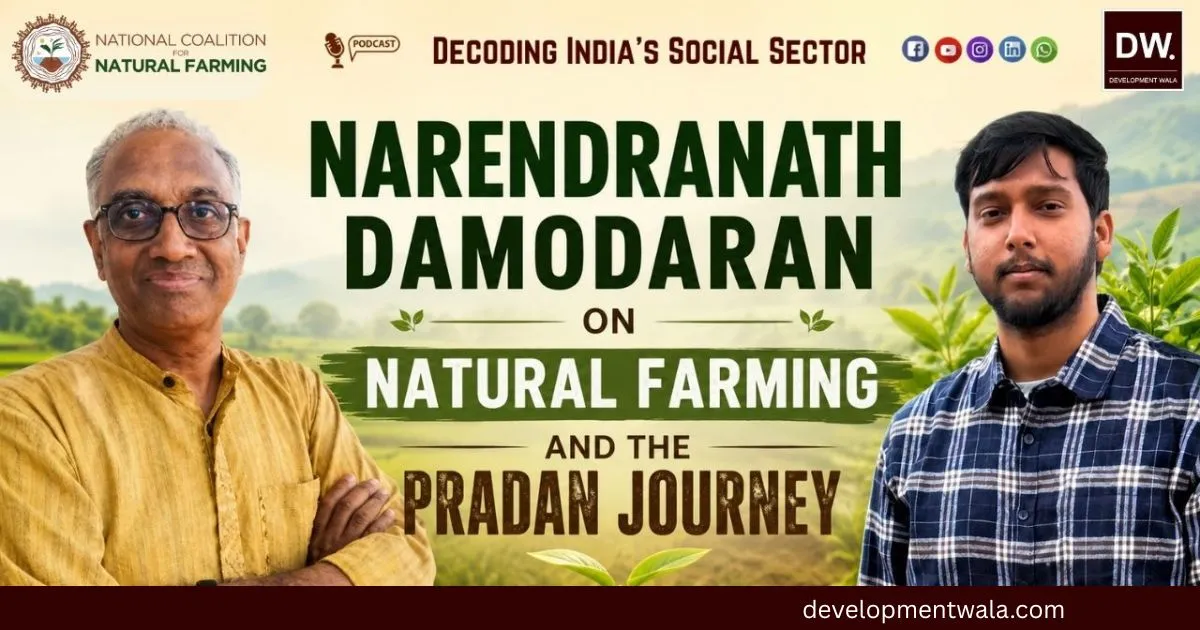
In a powerful episode of the Development Wala podcast “Decoding India’s Social Sector,” veteran development practitioner Narendranath Damodaran shared deep reflections from more than three decades of grassroots work across India’s rural communities.
Currently serving as the National Anchor of the National Coalition for Natural Farming (NCNF), Narendranath previously spent nearly 33 years with PRADAN, including five years as Executive Director, working extensively with Adivasi communities, women’s collectives, self help groups, livelihoods, and institution building.
This conversation was not just about agriculture. It was about dignity, community agency, policy reform, grassroots leadership, and what true development should actually mean in India.
Who is Narendranath Damodaran?
Narendranath Damodaran is among India’s most respected rural development practitioners and thinkers.
An alumnus of Institute of Rural Management Anand, he began his journey after studying mechanical engineering and later entering the field of rural management. His early field experiences in the tribal regions of Bihar and Jharkhand shaped his understanding of poverty, migration, inequality, and livelihoods.
Through decades of engagement with communities, he became deeply involved in institution building, women’s collectives, rural livelihoods, and later agroecology and natural farming movements.
Today, through NCNF, he is helping build a nationwide movement toward sustainable farming systems and ecological transition in India.
Watch the full podcast below:
Key Highlights from the Podcast
| Topic | Key Insight |
|---|---|
| Natural Farming | Farming with nature instead of against it |
| Soil Health | Chemical agriculture is degrading soil ecosystems |
| Women Farmers | Women are custodians of traditional agricultural wisdom |
| PRADAN Model | Long term grassroots engagement builds community agency |
| Policy Reform | Panchayats can drive ecological transformation |
| Rural Economy | Local food systems and decentralized economies matter |
| Young Professionals | Grassroots experience is essential before policy work |
| NCNF Vision | Supporting a large scale transition to agroecology |
Understanding Agroecology and Natural Farming
One of the most important discussions in the podcast revolved around the meaning of agroecology and natural farming.
According to Narendranath, agroecology is fundamentally about “farming with nature rather than farming against nature.”
Modern industrial agriculture often treats soil merely as a medium for extracting nutrients. However, natural farming sees soil as a living ecosystem filled with microorganisms, microbes, earthworms, and biological interactions that sustain plant life naturally.
He explained how plants and soil exist in a symbiotic relationship where nutrients, sugars, and microbial interactions continuously enrich one another.
Chemical intensive farming disrupts these natural cycles.
This disruption has resulted in:
Declining Soil Fertility
Continuous chemical usage has weakened soil structure and biodiversity.
Loss of Traditional Knowledge
Generations of farmers have slowly forgotten older ecological farming methods due to dependence on industrial agriculture systems.
Reduced Nutritional Value
Food grown under chemical intensive systems often loses nutritional quality and shelf life.
Ecological Stress
Overuse of pesticides and fertilizers has created long term environmental and health concerns.
Narendranath emphasized that natural farming is not about rigid terminology. Whether one calls it agroecology, organic farming, biodynamic farming, or permaculture, the broader objective remains the same: creating agriculture systems that work in harmony with nature.
The PRADAN Journey and Lessons from Rural India
A significant portion of the discussion focused on the evolution of PRADAN and what it taught generations of development practitioners.
Narendranath described how PRADAN adopted a fundamentally different approach to development work.
Instead of imposing ready made solutions from cities or government offices, PRADAN focused on patient grassroots engagement with communities.
The organization realized early that poverty is deeply complex and cannot be solved through one dimensional interventions alone.
Working with Women’s Self Help Groups
One of PRADAN’s most influential contributions was its early work with women’s self help groups before SHGs became mainstream in India.
The organization discovered that women’s groups provided:
• A consistent platform for engagement
• Community level financial systems
• Collective agency
• Confidence building
• Pathways for economic activity
This grassroots approach eventually influenced larger government programs including the National Rural Livelihood Mission.
Respecting Community Agency
A major philosophical insight shared during the podcast was that poor communities should never be treated merely as “beneficiaries.”
Narendranath strongly criticized top down development approaches where communities passively receive handouts without being empowered to shape their own futures.
Instead, he emphasized:
• Dignity
• Equal partnership
• Community agency
• Knowledge co creation
• Long term institution building
This remains one of the strongest messages from the entire conversation.
Why India Needs a Natural Farming Transition
India’s agriculture system today is trapped within multiple structural dependencies.
Narendranath explained how existing policy systems involving fertilizer subsidies, water subsidies, procurement systems, and market incentives continue to support chemical intensive agriculture.
At the same time, ecological consequences are becoming impossible to ignore.
The Soil Crisis
One of the central concerns raised was the degradation of soil ecosystems.
Natural farming movements across India are now documenting:
• Declining earthworm populations
• Reduced soil fertility
• Increased pest cycles
• Loss of biodiversity
• Water stress
This has enormous implications not just for farming but also for food security and public health.
The Need for Bottom Up Transformation
According to Narendranath, large scale ecological transition cannot happen only through central government policy announcements.
It must emerge as a bottom up farmer movement.
Farmers themselves need to reclaim knowledge systems, reduce dependency on chemical inputs, and rebuild local agricultural ecosystems.
This is where organizations like NCNF are playing a catalytic role.
The Role of Gram Panchayats and the 16th Finance Commission
A particularly important insight from the discussion was how Gram Panchayats can become central actors in ecological transformation.
Narendranath discussed how the 16th Finance Commission and untied grants to local bodies could create opportunities for “Green Villages.”
Instead of focusing primarily on conventional infrastructure, Panchayats can invest in:
• Soil conservation
• Water management
• Bio resource centers
• Agroecological infrastructure
• Local food systems
• Farmer support ecosystems
This approach could fundamentally reshape rural development planning in India.
Women Farmers and Food Sovereignty
One of the strongest themes throughout the podcast was the central role of women in agriculture and ecological knowledge systems.
Narendranath repeatedly emphasized that women are the real custodians of agricultural wisdom.
Women often:
• Manage livestock
• Preserve seeds
• Work continuously on farms
• Understand local ecosystems
• Maintain biodiversity practices
• Pass down traditional knowledge
However, despite doing most of the agricultural work, decision making often remains male dominated.
This disconnect has contributed to the erosion of traditional ecological wisdom.
Community Seed Banks and Seed Mothers
The discussion around “Seed Mothers” and community seed systems highlighted how women play a vital role in preserving indigenous seeds and biodiversity.
These systems are not only about seeds themselves but also about preserving:
• Local food cultures
• Farming practices
• Ecological resilience
• Nutritional diversity
Food sovereignty, therefore, becomes deeply connected to women’s leadership.
Why Consumer Behavior Must Change
An important argument raised in the conversation was that agricultural transformation cannot happen without changing consumption patterns.
Narendranath pointed out that current food systems are shaped heavily by processed foods, monocultures, and industrial supply chains.
If consumers demand only standardized processed foods, farmers will continue to cultivate accordingly.
The Case for Local Food Systems
NCNF advocates for:
• Local production
• Local processing
• Local marketing
• Diverse food systems
• Seasonal consumption
This model could generate healthier food ecosystems while also creating local employment opportunities for rural youth.
He also highlighted the importance of millets and traditional foods, noting that policy support alone is insufficient unless consumer demand also grows.
How Knowledge Systems Need to Change
One of the most powerful insights from the episode was the idea that natural farming is fundamentally a “knowledge movement.”
Unlike conventional agriculture where knowledge flows top down through universities and extension systems, natural farming requires rediscovering and documenting community based knowledge.
Narendranath warned that traditional agricultural wisdom is rapidly disappearing because newer generations no longer practice or remember older systems.
He even noted that ecological knowledge exists in:
• Folk songs
• Oral traditions
• Rituals
• Women’s practices
• Community memory
This makes knowledge conservation an urgent priority.
Advice for Young Professionals in the Social Sector
Toward the end of the conversation, Narendranath shared deeply practical advice for young people interested in rural development, policy, climate, and the social sector.
Spend Time at the Grassroots
His strongest advice was simple:
“Go work in the villages.”
He encouraged young professionals to spend the first several years of their careers understanding real ground realities instead of immediately chasing policy or corporate positions.
Learn Through Practice
According to him, real understanding comes from:
• Experimenting
• Failing
• Working directly with communities
• Building relationships
• Observing systems firsthand
Respect Community Knowledge
Professionals may bring technical expertise, but solutions must be co created with communities rather than imposed externally.
Build Strong Skills
Young practitioners should also develop deep professional competencies in areas like:
• Research
• Agriculture
• Policy
• Management
• Finance
• Community organizing
• Data systems
• Climate adaptation
Why This Conversation Matters Today
This podcast is far more than a discussion on farming.
It is a reflection on the future of development itself.
At a time when conversations around climate change, sustainability, food systems, migration, and livelihoods are becoming increasingly urgent, Narendranath Damodaran offers a grounded perspective rooted in decades of practice.
His reflections challenge many dominant assumptions around:
• Development
• Policy making
• Poverty alleviation
• Agriculture
• Welfare systems
• Market led growth
Most importantly, the conversation reminds us that sustainable development cannot be separated from dignity, participation, and ecological balance.
Conclusion
India’s future will depend heavily on how it reimagines rural development, agriculture, and ecological sustainability.
The ideas shared by Narendranath Damodaran offer an important roadmap for that future.
From strengthening Gram Panchayats and supporting women farmers to rebuilding soil ecosystems and transforming food systems, this conversation provides practical lessons for policymakers, researchers, development practitioners, students, and young professionals alike.
As India navigates climate challenges, rural distress, and ecological decline, movements around natural farming and agroecology may become not just alternatives but necessities.
For anyone interested in rural development, public policy, sustainability, climate action, or social sector careers, this episode is an essential listen.
Tags: natural farming india, agroecology india, narendranath damodaran, PRADAN, NCNF, rural development india, women farmers india, soil health, sustainable agriculture, gram panchayat development, social sector careers, development wala podcast, food sovereignty, ecological farming, community development
Decoding India’s Social Sector is a podcast series by Development Wala that brings these stories to the forefront — creating a platform for voices from the ground, practitioners, leaders, and changemakers who are shaping development across India.
Share Your Story with India’s Social Sector:
Discover more from Development Wala
Subscribe to get the latest posts sent to your email.