
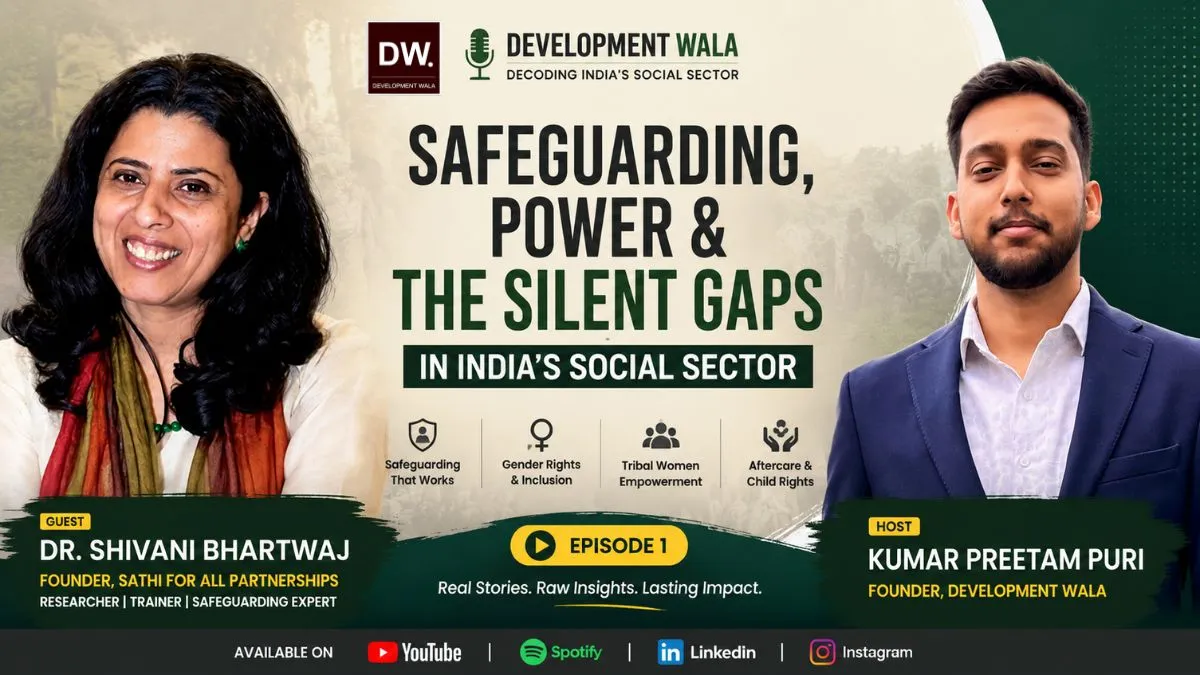
India’s social sector is often celebrated through impact reports, policy launches, and development indicators. But behind every policy document lies a difficult question. Are these systems truly protecting the people they are designed for?
In the first episode of Decoding India’s Social Sector, Dr. Shivani Bhardwaj shared powerful insights from decades of work across safeguarding, gender justice, child rights, tribal development, labor rights, and policy implementation. The discussion explored the realities behind India’s development ecosystem and the invisible gaps that continue to affect vulnerable communities.
The episode highlighted one central truth. Development is not only about creating schemes or writing policies. It is about whether people can actually access dignity, safety, resources, and opportunity in their daily lives.
Why Safeguarding in India Still Remains Weak
Safeguarding has become a widely used term in NGOs, international development organizations, schools, and institutions across the world. Yet in India, safeguarding systems are still poorly understood and inconsistently implemented.
According to Dr. Bhardwaj, the biggest obstacle is not the absence of policy. The real challenge is mindset and power structures.
Many institutions avoid confronting abuse, harassment, or exploitation because people fear damaging relationships, challenging authority, or exposing influential individuals. As a result, safeguarding often remains limited to paperwork instead of becoming part of institutional culture.
She explained that effective safeguarding training cannot rely only on compliance or formal rules. It must engage people emotionally and ethically by helping them reconnect with empathy, relationships, humanity, and accountability.
This becomes especially important in sectors dealing with children, women, marginalized communities, persons with disabilities, and vulnerable populations.
Gender Rights and the Reality of Policy Implementation
One of the strongest observations from the podcast was the gap between policy and implementation in India’s social sector.
Government schemes for women empowerment, rural livelihoods, self help groups, and tribal welfare exist in large numbers. However, Dr. Bhardwaj pointed out that many communities still struggle to access these systems meaningfully.
While working with Gond and Baiga tribal women in Madhya Pradesh, she helped support a community based concept called the “Jungle Bank.”
The initiative focused on:
- collective seed preservation
- forest based livelihoods
- community storage systems
- local biodiversity protection
- reducing dependency on moneylenders
Instead of depending entirely on external financial institutions, tribal women developed their own local systems for resource sharing and sustainability.
The idea reflected an important lesson in grassroots development. Communities often create solutions long before formal institutions arrive.
The Gender Resource Gap in India
During the conversation, Dr. Bhardwaj introduced the concept of the gender resource gap, an issue that extends far beyond salary inequality.
The gender resource gap includes unequal access to:
- land ownership
- productive assets
- education
- technology
- internet access
- social networks
- inheritance
- healthcare
- mobility
- leadership opportunities
In many regions, women still face restrictions on owning property, using digital tools, accessing financial systems, or participating in public decision making.
She also highlighted how women frequently lack control over resources even when schemes are technically designed for them. For example, women may receive financial support or loans, but social and family structures often continue controlling how those resources are used.
At the same time, she acknowledged that awareness among women has significantly changed over the past few decades. More women today aspire to own homes, land, businesses, and productive assets independently.
That shift in consciousness represents one of the most important transformations happening within India’s development landscape.
Why Inclusive Safe Spaces Matter
The conversation also explored the meaning of inclusive safe spaces.
For Dr. Bhardwaj, inclusion is not simply about representation or diversity. A truly inclusive space is one where people feel safe, respected, nurtured, and free from fear.
This includes freedom from discrimination based on:
- gender
- caste
- religion
- sexuality
- disability
- economic background
- identity
She emphasized that violence and exclusion are deeply connected to historical systems of resource control and power imbalance. Therefore, building inclusive systems requires intentional efforts centered around care, dignity, and collective wellbeing.
This perspective is particularly relevant today as conversations around gender equality, LGBTQ+ inclusion, child protection, and workplace safety continue expanding across India.
Challenges in NGO Work and Social Sector Employment
The podcast also offered important reflections on the changing nature of labor and employment within the social sector.
Dr. Bhardwaj discussed how contractual work, consultant based assignments, and temporary hiring structures have increasingly replaced stable employment across NGOs and development organizations.
This creates several challenges:
- weak accountability structures
- limited worker protection
- reduced long term institutional commitment
- inconsistent safeguarding implementation
- burnout among social sector professionals
She also pointed out that many safeguarding policies technically apply to volunteers, consultants, and contractual workers, but enforcement remains weak.
Another major concern raised during the discussion was the growing exhaustion within the development sector. Many professionals enter the field with passion and purpose but eventually struggle with emotional fatigue, unstable work conditions, and lack of institutional support.
The Crisis of Aftercare for Children Leaving Institutions
One of the most emotional parts of the conversation focused on aftercare systems for children leaving institutional care after turning 18.
Dr. Bhardwaj discussed her work with aftercare initiatives supported by organizations like UNICEF and Udayan Care. While policies for care leavers exist, implementation remains inconsistent and underfunded.
Many young adults leaving child care institutions struggle with:
- housing insecurity
- employment challenges
- social stigma
- lack of family support
- financial instability
- emotional isolation
She shared an example of an orphaned young man who had stable income, property, and financial independence but still struggled to find acceptance within society because of the stigma attached to growing up without family structures.
The story reflected a larger issue within Indian society. Economic independence alone does not always guarantee social inclusion or dignity.
Safeguarding Is About Prevention, Not Just Punishment
One of the most important takeaways from the episode was that safeguarding should focus on prevention rather than only reacting after harm occurs.
Creating safe systems requires:
- awareness
- institutional accountability
- ethical leadership
- proper training
- community participation
- empathy driven policy implementation
Dr. Bhardwaj emphasized that safeguarding is fundamentally about how power and resources are distributed within society.
When institutions prioritize dignity, inclusion, and wellbeing, safer environments become possible.
Advice for Young Professionals Entering the Development Sector
Toward the end of the podcast, Dr. Bhardwaj shared advice for young professionals interested in social work, policy, gender rights, development practice, and NGO careers.
Her guidance focused on:
- reading deeply
- understanding systems
- strengthening technical skills
- maintaining ethical integrity
- listening to communities carefully
- balancing empathy with professionalism
She also addressed a difficult reality many practitioners face. Sometimes organizations pressure professionals to dilute uncomfortable findings or soften critical recommendations.
This creates a constant ethical tension between serving employers and serving vulnerable communities honestly.
For many working in development, this remains one of the hardest challenges.
The Future of India’s Social Sector Depends on Listening
The conversation with Dr. Shivani Bhardwaj ultimately revealed something larger about India’s development ecosystem.
Communities already understand their realities. Women, tribal communities, workers, care leavers, and marginalized groups often know exactly what support they need.
The real question is whether institutions are willing to listen.
As India’s social sector continues evolving through NGOs, CSR initiatives, international development partnerships, fellowships, and grassroots movements, conversations around safeguarding, gender justice, inclusion, and ethical leadership will become increasingly important.
Development cannot only be measured through reports or numbers.
It must also be measured through dignity, safety, belonging, and the ability of people to live without fear.
Connect with Dr. Shivani on LinkedIn: https://www.linkedin.com/in/dr-shivani-bhardwaj-5722ba6/
Decoding India’s Social Sector is a podcast series by Development Wala that brings these stories to the forefront — creating a platform for voices from the ground, practitioners, leaders, and changemakers who are shaping development across India.
Share Your Story with India’s Social Sector:
Discover more from Development Wala
Subscribe to get the latest posts sent to your email.