
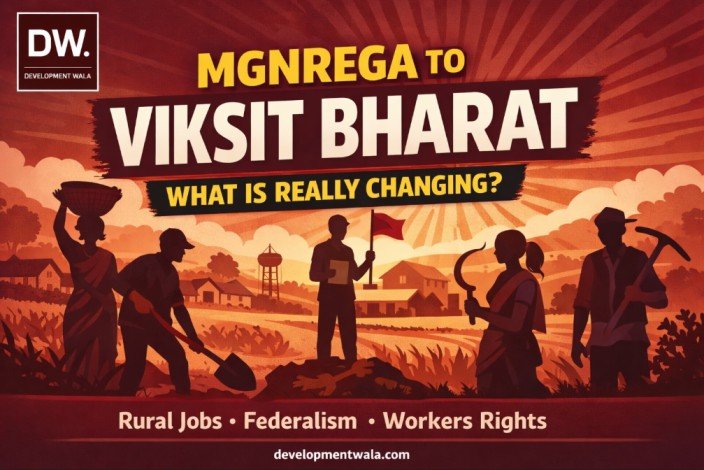
India’s rural employment guarantee was never designed as charity. It was not meant to be a temporary welfare scheme that governments could switch on or off based on political convenience. When the Mahatma Gandhi National Rural Employment Guarantee Act was passed in 2005 it created something rare in Indian public policy. A legal right to work.
For nearly two decades MGNREGA gave rural households a powerful tool. Any adult could demand work and the state was legally bound to provide employment within fifteen days. If the state failed the worker was entitled to compensation. This demand driven structure made MGNREGA enforceable accountable and rights based.
Now that structure is under threat.
In 2025 the Union Government introduced a proposal to repeal MGNREGA and replace it with a new law called the Viksit Bharat Guarantee for Rozgar and Aajeevika Mission Grameen Bill often shortened to VBG RAMG. On the surface the bill claims to expand rural employment by increasing guaranteed work from 100 days to 125 days per year. But a closer reading reveals a much deeper transformation.
This is not just a policy tweak. It is a fundamental shift in how rural employment is defined funded and governed in India.
This blog explains what is changing why it matters and how the proposed law could reshape federalism welfare and workers rights in rural India.
Why MGNREGA Was Different From Other Welfare Schemes
To understand the impact of the new bill it is important to first understand why MGNREGA mattered so much.
MGNREGA was not just about wages or infrastructure. It was about citizenship and accountability.
Under the Act
Employment was demand driven
Work had to be provided within fifteen days
Failure triggered unemployment allowance
Wages were paid by the Union Government
Workers could legally challenge non compliance
This structure ensured that rural employment was not dependent on state discretion or budget mood. The financial responsibility rested largely with the Centre so poorer states were not penalised for having weaker revenues.
MGNREGA was also shaped through wide consultations involving state governments economists civil society organisations and Parliament. It enjoyed rare political consensus across parties and regions.
Replacing such a law is not a neutral administrative act. It carries ideological and structural consequences.
The Politics Behind Renaming MGNREGA
One of the first things that drew attention was the name change.
Opposition leaders social activists and policy scholars have criticised the removal of Mahatma Gandhi’s name. The original name carried historical moral and symbolic weight. It linked the programme to ideas of dignity labour and non violent justice.
The new title Viksit Bharat Rozgar and Aajeevika Mission Grameen signals a shift in language. Instead of a rights based guarantee it sounds like a government initiative or mission.
Activists like Aruna Roy and Nikhil Dey argue that this renaming is not cosmetic. It reflects a move away from legally enforceable rights towards executive controlled schemes.
There is also criticism around the use of Hindi terms such as Rozgar and Aajeevika and the inclusion of Ram in the abbreviation. Many see this as part of a broader cultural nationalist branding that replaces constitutional language with ideological symbolism.
Editorials and commentators have pointed out that the RSS has historically opposed MGNREGA and held strong differences with Mahatma Gandhi. Against this backdrop the renaming appears politically loaded rather than administrative.
From Demand Driven Employment to Allocation Driven Employment
The most important change in the new bill lies in how employment is triggered.
Under MGNREGA
Work begins when a worker demands it
Under VBG RAMG
Work depends on central notifications approved schemes and allocated budgets
This is a critical shift.
Even though the bill mentions 125 days of work the guarantee is no longer automatic. Employment is no longer activated simply because a worker asks for it. It depends on whether the Union Government has notified schemes approved funding and released money.
Economists warn that this weakens the very idea of a guarantee. Without automatic obligation the right to work becomes conditional.
Jean Dreze one of the key architects of MGNREGA has stated that the new law promises employment without guaranteeing delivery.
In practical terms this means rural workers may now wait not just for local work but for central approval.
The Silent Transfer of Financial Risk to States
Another major shift is financial.
Under MGNREGA
The Union Government paid all unskilled wages
Most material costs were covered by the Centre
States had limited financial exposure
Under the proposed law
Funding shifts to a 60 40 model
States must contribute 40 percent of costs
This change comes at a time when states are already facing severe fund delays.
As of December 2025 pending MGNREGA dues crossed 9400 crore rupees. These include unpaid wages and material costs. States such as Andhra Pradesh Kerala Tamil Nadu Karnataka and Telangana have reported prolonged delays leaving workers unpaid for weeks or months.
Forcing states to now bear 40 percent of costs creates strong incentives to limit employment rather than expand it.
Poorer states may struggle to raise matching funds. Better performing states may be penalised for having lower poverty ratios under indices like the Multidimensional Poverty Index.
In both cases the result is fewer days of work.
How Federalism Is Being Weakened
The proposed bill centralises control while decentralising liability.
The Union Government retains power over
Allocations
Rules
Coverage
Technology systems
States inherit
Financial risk
Legal liability
Payment delays
Unemployment allowances
Even when delays are caused by the Centre not releasing funds states are expected to compensate workers.
This imbalance undermines cooperative federalism.
Critics warn that such a model allows the Centre to control outcomes without bearing consequences while states shoulder blame for failures they cannot prevent.
The experience of West Bengal is often cited. For over three years MGNREGA funds were withheld citing alleged irregularities even after court orders. Workers lost wages while the Centre faced little accountability.
The new law risks normalising such situations across states.
Suspending Work During Agricultural Seasons
The bill also allows states to suspend employment for up to sixty days during peak agricultural seasons.
The stated objective is to ensure availability of farm labour. However evidence does not support claims that MGNREGA causes widespread labour shortages.
Data on rural wages does not show sustained spikes attributable to MGNREGA. Factors such as mechanisation crop diversification and migration play much larger roles.
CPIM MP John Brittas has criticised this provision arguing that halting public employment to push workers into private farms amounts to state managed labour supply rather than welfare.
This effectively prioritises private agricultural employers over workers right to public employment.
Technology Controls and Worker Exclusion
Technology based governance has already created exclusion under MGNREGA and the new bill expands these mechanisms.
The law formalises
Biometric attendance
Aadhaar based payments
Geo tagging
Mandatory e KYC
While these tools are framed as transparency measures their real world impact has been exclusion.
Connectivity failures biometric mismatches and authentication errors have led to mass job card deletions and wage denials.
By April 2025 nearly 27 percent of workers were ineligible for Aadhaar based payments. Over 1.2 crore job cards have been deleted since 2019.
Under the new framework workers risk losing wages entirely due to technical failures beyond their control with limited grievance redressal.
For a programme meant to serve the poorest this raises serious ethical and policy concerns.
The Myth of Expanding Work From 100 to 125 Days
Supporters of the bill highlight the increase in guaranteed days from 100 to 125.
On paper this sounds progressive. In reality it is misleading.
Even under MGNREGA average employment per household has fallen to around 50 to 55 days due to budget constraints payment delays and administrative hurdles.
Raising the ceiling without fixing
Budget adequacy
Timely payments
Wage rates
Grievance systems
does not improve outcomes.
As Aruna Roy has argued real reform would strengthen enforcement not dilute responsibility.
What This Means for Rural Workers
At its core the VBG RAMG bill reshapes responsibility.
The Centre controls money and rules
States absorb financial and legal risk
Workers face uncertainty instead of rights
What was once a legally enforceable claim risks becoming a discretionary scheme.
For rural households MGNREGA was often the last safety net during drought migration job loss and economic shocks. Weakening this guarantee could deepen rural distress especially in times of climate volatility and economic slowdown.
Why This Debate Matters Beyond Rural Employment
This is not just about one scheme.
It is about
The future of rights based welfare in India
The balance of power between Centre and states
The accountability of governments to citizens
The dignity of labour
When journalism stops asking who benefits who pays and who is left out democracy weakens.
The proposed replacement of MGNREGA deserves careful scrutiny not just applause for headline numbers.
Final Thoughts
MGNREGA was imperfect but it was powerful because it was enforceable.
Replacing it with a centrally controlled scheme that shifts risk downward while retaining authority upward marks a profound change in India’s welfare architecture.
If India is serious about inclusive development strengthening rural livelihoods and protecting constitutional values then any reform must expand rights not dilute them.
Development is not about rebranding. It is about responsibility accountability and trust between the state and its people.
References
Press Information Bureau, Government of India (2025) Viksit Bharat G RAM G Bill 2025: Reforming MGNREGA for Viksit Bharat. Posted on 18 December 2025. New Delhi: PIB. Available at: https://pib.gov.in (Accessed: 18 December 2025).
The Hindu (2025) Centre to bring new rural employment bill to replace MGNREGA in Parliament. Available at: https://www.thehindu.com/news/national/centre-to-bring-new-rural-employment-bill-mgnrega-parliament/article70397900.ece (Accessed: 18 December 2025).
Prasanna, P. (2025) MGNREGA vs VB G RAM G: What changes for states and workers. Let Me Explain, Episode 106. YouTube video. Available at: https://youtu.be/4Ct8q2MJ-Xg (Accessed: 18 December 2025).
Ministry of Rural Development, Government of India (2025) Mahatma Gandhi National Rural Employment Guarantee Act official website. Available at: https://nrega.dord.gov.in/MGNREGA_new/Nrega_home.aspx (Accessed: 18 December 2025).
Youtube: https://www.youtube.com/@Development_Wala
Follow us on Instagram: https://www.instagram.com/development.wala
Linktree Profile: https://linktr.ee/developmentwala
Discover more from Development Wala
Subscribe to get the latest posts sent to your email.